The laws of chemical combinations created beat back in the stagnant pole of chemistry. They sanctioned scientists to carry out various experiments that help in forming strong foundations in chemistry. However, proof and experimental evidence are still required for these laws. It was around 1801-1810 that a physicist and a chemist from England named John Dalton was successful in answering these questions. A theory was proposed by him known as Dalton’s Atomic Theory.
With the theory proposed by John Dalton many concepts regarding matter, atoms, the composition of matter, and even the combination of atoms resulting in compounds is better understood. On the law of constant proportion and the law of conservation of mass, Dalton grounded his theory. There are 6 postulates proposed by Dalton in his theory known as Postulates of Dalton’s Atomic Theory.
The Postulates of Dalton’s Atomic Theory is as follows:-
Dalton’s Atomic Theory includes 6 postulates –
A new unit is formed in a chemical reaction by the combination of atoms. Neither the existing atom can be destroyed nor is a new atom formed. Only the arrangements of the atom change in the chemical reaction to form a unit, no new atoms are formed, so atoms are fundamental units. For example,
2H2 + O2 → 2H2O
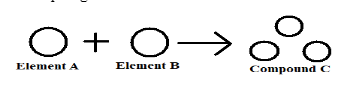
Therefore, if 2H2 is considered as element ‘A’ and O2 as element ‘B’ then 2H2O is a compound formed by just changing the arrangement without forming any new atom.
For example, the Tip of a pencil is made up of carbon atoms and also gold ornaments are made up of gold atoms. Like element ‘A’ and element ‘B’ together form compound ‘C’.
O2 → O + O
Both the atoms have the same mass i.e. 16µ and the same chemical properties.
The ratio combinations of atoms are always in the whole number.
For example,
CO2 =1:2, i.e. CO2 contains one atom of carbon and 2 atoms of oxygen. Therefore the ratios are in the whole number and not in numbers like ½ or ¾ etc.
For example,
HCl → H + Cl
As there are two different atoms hydrogen and chlorine. So both the atoms have different masses and different chemical properties.
For example,
CO2 → C + O2
Therefore, the compound contains one carbon atom and two oxygen atoms and it remains the same always.
Drawbacks of Dalton’s Atomic Theory are as follows:-
It is to conclude that with the theory proposed by John Dalton many concepts regarding matter, atoms, the composition of matter, and even the combination of atoms resulting in compounds is better understood. There are 6 Postulates of Dalton’s Atomic Theory which also have several drawbacks or limitations.


 Profile
 Settings
 Refer your friends
 Sign out