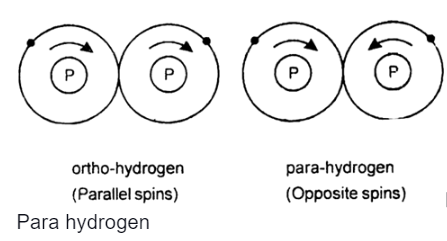
The lightest element, hydrogen, exists in its standard elemental form as a diatomic molecule, called dihydrogen, H2. The atomic structure of hydrogen can only exist at high temperatures. The diatomic form of hydrogen consists of two hydrogen atoms. Each atom comprises a proton in its nucleus and an electron around it. Just like the electron, the proton is also spinning about an axis.
The two protons of the hydrogen molecule may be either spinning in the same direction or opposite directions in their nucleus, giving rise to two forms of hydrogen, i.e., ortho and para.
Ortho hydrogen molecules are in which the spin of both protons in the nucleus is in the same direction. The Ortho form of hydrogen is more stable than the para form, but it is challenging to obtain a pure ortho form.
Physical properties of ortho hydrogen:-
Para hydrogen molecules are defined as the ones in which the spins of both the protons in the nucleus are in opposite directions.
Physical properties of para hydrogen:-
Para hydrogen was initially prepared by absorbing ordinary hydrogen in activated charcoal in a quartz vessel. The solution was maintained at a temperature of 20K. The charcoal absorbs almost pure para hydrogen. Hence, by this method, pure para-hydrogen can be isolated.
Hydrogen in its ordinary form exists as an equilibrium mixture of ortho and para hydrogen.
Ortho hydrogen ⇌ Para hydrogen
Ordinary hydrogen at room temperature and normal atmospheric conditions is a mixture of ortho-form and para-form in the ratio of 3:1, i.e., ordinary hydrogen consists of about 75% ortho and 25% para form.
As the temperature decreases, the equilibrium shifts in favour of para hydrogen.
This conversion of ortho form into the para form on increasing temperature shows that the intrinsic energy of ortho form is higher than para form.
Though the two forms differ in physical properties, they show similar chemical properties.
Depending upon the direction of spins of the protons in nuclei of diatomic hydrogen, hydrogen is of ortho and para form, which exist as an equilibrium mixture at room temperature in a ratio of 3:1. Among the two states of hydrogen, though the ortho form of hydrogen is more stable than the para form, it is challenging to obtain a pure ortho form. The two forms differ in physical properties, but they show similar chemical properties.


 Profile
 Settings
 Refer your friends
 Sign out