A capacitor is a passive electronic component used to store electrical charge in an electrical field. Capacitors, resistors, and inductors are the most common electronic components of any electrical circuit. It is extremely rare for a circuit not to comprise a capacitor as a component. Capacitors are useful because they can store energy in the form of an electric field. They are used in circuits because they can act like charged batteries. However, even though capacitors can store energy, they can also lose this energy over time due to discharging. Capacitors gradually lose their charge, becoming discharged. Capacitance is the effect of capacitors. Any two conductors in close proximity can have capacitance. However, a capacitor is designed specially to augment capacitance in a circuit.
The discharging of a capacitor simply means that the charge stored in the capacitor is released from the capacitor. This can be understood better with the help of studying a circuit.
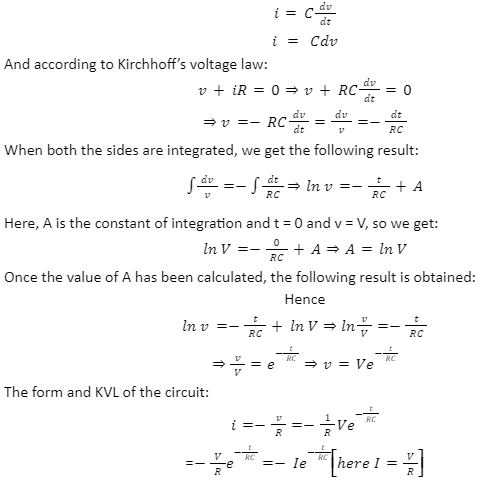
Imagine a circuit made up of a capacitor connected in series to a resistor. The capacitance of the capacitor is C farad, and the resistance of the resistor is R ohms. This circuit has a push-button switch. When the button is pushed, the capacitor is short-circuited and starts discharging. Assume that the full voltage of the capacitor is V volts. The value of the current that is discharging as a result of the capacitor being short-circuited is -V/R amperes. When the switch is turned on by pushing the button, the current in the circuit is given by the following equation:
Capacitors can be found almost universally in all electronic products. Some of their major uses are as follows:
While capacitors are very useful electrical components, they can also be hazardous if not handled carefully. Most of the hazardous qualities of capacitors come from the amount of energy stored in them. That is why it is important to understand the discharging of a capacitor. If capacitors are handled with due precaution, they have many uses. They are used in digital circuits to prevent the loss of information stored in computers in case of a sudden shortage in power supply.



 Profile
 Settings
 Refer your friends
 Sign out