For a given charge distribution, the locus of all the points having the same potential is called Equipotential Surface.
Equipotential surface, as the name defines, is a surface on which potential is equal everywhere. It means that if we draw a surface in such a way that the electric potential is the same at all the points of the surface, then it is said to be an equipotential surface.
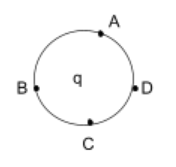
Here are some examples of equipotential surfaces:
Where, the potential at points A, B, C, D will be equal.
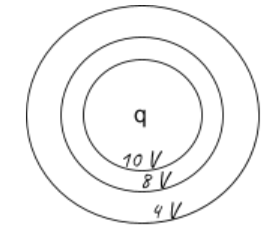
“Concentric spheres with a charge at the centre of spheres are equipotential surfaces.”
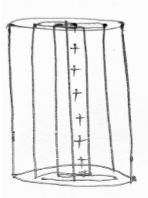
“Concentric cylinders with a linear charge at the axis of cylinders are equipotential surfaces.
Let us explore how to visualise equipotentials. One way of doing that is by drawing something called Equipotential surfaces.
(VA-VB) = 0
Or
VA = VB
Now, it is time to go through some problems on equipotential surfaces.
As the name suggests, these are 3D surfaces over which potential (V) at every point is equal.
The surfaces are closer to the centre and are going farther and farther away. Why is that?
Well, it has got something to do with the strength of electric fields. Electric force close to the charge is very strong, so equipotential surfaces are closer. As we go farther away from the charge, the field weakens, and so, the surfaces go farther away from each other.
The relation between electric field and potential is given as
E = V/d
Where E is the electric field,
V is the potential, and
d is distance.
So as the distance increases on the equipotential surface then the potential will be constant so the value of the electric field will decrease.
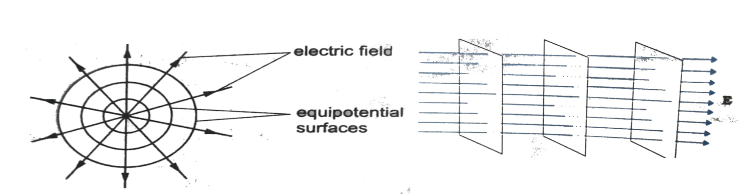
If you want to draw an equipotential surface, then just draw the electric field
lines first and then make a surface perpendicular to it. This will be your
equipotential surface.
Here are some examples:
The equipotential surfaces are in the XY plane. As the magnitude of the field increases along the positive Z direction, the distance between successive equipotential surfaces decreases.
If electric fields were constant, the distance between successive equipotential surfaces would stay constant.
Work done can be calculated by the following formula
W = -qΔV
Given q = 10 C
Since the particle is moving on an equipotential surface ΔV= 0.
So work done W = 0.
An equipotential surface is that surface where the value of potential is the same at any point on the surface. This shows that potential V is constant if distance ‘r’ is constant. If you are given any charge distribution, then first draw electric field lines through the given distribution and then make a surface perpendicular to lines. This will be an equipotential surface to that of the given charge distribution.



 Profile
 Settings
 Refer your friends
 Sign out