A prism is a polyhedron having five sides and a triangular cross-section. There are two identical parallel triangles opposite each other in a prism. Three rectangular surfaces are also inclined to each other, in addition to the triangles. Prisms are translucent solids that are used to refract light. The refracting surfaces are the two sloped rectangular surfaces through which light flows. The refracting edge of the prism is the angle generated between these two refracting surfaces. The major section of the prism is the part of the prism that is perpendicular to the refracting edge. The prism’s base is the third rectangular surface at the bottom.
A prism is a transparent, three-dimensional object with two flat polished surfaces that are inclined at an acute angle to one another. Light reflects off of these surfaces.
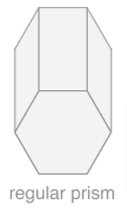
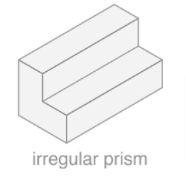
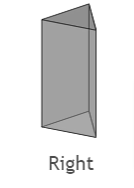
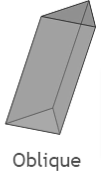
Prisms are divided into several categories, as listed below:
When light goes from one medium to another, it bends. Refraction is the name for this occurrence.
Violet, Indigo, Blue, Green, Yellow, Orange and Red are the seven colours that make up white light. The difference in the refractive index of the two mediums causes light to bend whenever it enters a prism. Depending on their wavelengths, the various constituents of white light diverge at different angles.
Since violet has the shortest wavelength, it has the most deviation, while red has the longest wavelength and has the least departure. The prism refracts seven colours of light at different angles in this fashion.
Dispersion is the term for the separation of white light into its constituent colours.
The following are some basic definitions and formulas for the concept:
The prism formula is as follows in general:
Surface Area of a Prism = 2 × Base Area + Lateral Surface Area
Volume of a Prism = Base Area × Height
According to Snell’s law, we know that,
=sin isin r
δ = i1 – r 1+ i 2– r2
δ = i1 + i 2-( r1+ r2) ….(i)
∠ALO + ∠AMO = 2rt∠s
∠LAM + ∠LOM = 2rt∠s….(ii) (sum of 4 angles of a quadrilateral = 4 rt∠s)
r1 + ∠r2 + ∠LOM = 2rt∠s……(iii)
∠LAM = ∠r 1 + ∠r2 ….(comparing eq(ii) and eq(iii))
A = ∠r1 + ∠r2
Substituting the value of A in eq(i)
δ =i1 + i 2 – A
i1 + i 2 = A + δ
i1 = ∠ i 2
r1 = ∠r2 = ∠r
∠ALM = ∠LMA = 90° – ∠r
Thus, AL = LM and LM ∕∕ BC
∠A = ∠r1 + ∠r2
A = 2r….(Since r1 = ∠r2 = ∠r)
r = A/2
i1 + i 2 = A + δ
i1 + i 2 = A + δm
2i1 = A + m
i1 = A + m/2
According to Snell’s Law,
μ = sini/sinr
∴ = {sin (A+ m)/2} / (sin A/2)
A prism is a clear, polished flat optical element that reflects light, according to physics. These can be created out of any transparent material with the appropriate wavelengths. Glass, fluorite and plastic are the most regularly utilised materials.
A prism is a polyhedron with two polygonal bases that are parallel to each other. The prism is a transparent optical element that refracts light and has flat polished surfaces in optics. The two polygonal bases are joined by lateral sides, which are generally rectangles. In rare circumstances, it could be a parallelogram. The prism principle can be applied to both mathematics and science.
To break the light into its spectral hues, dispersive prisms are used. Prisms can also be used to split light into its constituents using light polarisation or to reflect light.



 Profile
 Settings
 Refer your friends
 Sign out