When an object is moving with respect to the observer, then a phenomenon is observed, which is known as the Doppler effect. A typical example of the Doppler effect is when an ambulance comes closer to you from the back, and the siren is on. You will observe an increase in the sound when the van comes closer to you. However, once the van moves away from you, the sound decreases. In this case, you can judge the distance of the ambulance van only by hearing the sound of the siren.
The various factors that contribute to the Doppler effect are:
Doppler effect is generally expressed as follows:
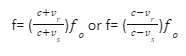
c is the speed of propagation of waves in the medium
vr is the speed of the receiver with respect to the medium; +c if the receiver is moving toward the direction of the source and -c if the receiver is moving opposite to the source.
vc is the speed of the source with respect to the medium +c if the receiver is moving towards the direction of the source and -c if the receiver is moving opposite to the source.
This equation varies according to the velocity of the observer and the speed of the sound.
If the medium is moving, then there will be two cases. We will discuss those two cases in the following section:
The Doppler effect is not without drawbacks. The demerits of the Doppler effect is that it comes into play or can be observed only:
The Doppler effect finds its applications in vast fields like:
This article covers almost everything on this important topic of the effect of motion of medium on apparent frequency. The main principle working behind these phenomena is the Doppler effect.
You will learn about the Doppler effect, followed by cases of the Doppler effect. The formula of the Doppler effect varies according to different scenarios, e.g. if the source is approaching the observer or the observer is approaching the source and with what velocity and speed. In the end, you will also learn about the limitations and applications of the Doppler effect.



 Profile
 Settings
 Refer your friends
 Sign out


