To completely understand the application of alternating current meaning, we are going to discuss one of the most typical uses for alternating current (AC), such as energy generation and transmission. Unlike direct current (DC), which is used in batteries, almost every home in the world is powered by alternating current (AC). This current is preferred over DC current due to cost, power loss and conversion difficulties from higher voltage to lower voltage.
Short and medium-distance AC current moves with low power loss.
Before we get into why these are the most common applications to create alternating current application notes, it’s important to understand a bit of this type of energy. These currents are produced by rotating a magnet around stationary wire coils. The coils generate an electric wave because one end of the magnet is positive and the other is negative. This wave’s frequency varies, but most power plants emit it between 50 and 60 times per minute.
Alternating current is the flow of charge that changes direction on a regular basis. As a result, the voltage level reverses with the current. AC is used to power, among other things, houses, buildings and offices.
An alternator is a device that can create an alternating current. This device is a type of electrical generator that generates alternating currents.
A wire loop is rotated inside a magnetic field, causing a current to flow along the wire. The spinning of the wire is caused by many resources such as a steam turbine, a wind turbine, flowing water and so on. Because the wire rotates and enters a new magnetic polarity on a regular basis, the voltage and current on the wire alternate. Here is a simple graphic that illustrates this principle:
To create an alternating current in a series of water pipes, we link the mechanical features of a piston that propels water back and forth in the pipes (our “alternating” current).
Following are the uses of alternating current:
An alternating current motor, also known as a direct current motor, is a type of electric motor that uses alternating current to power a stator and a coil to convert electric current into mechanical power. The stator is the stationary component of the motor, while the rotor is the spinning component. There are single-phase and three-phase AC motors available, with three-phase motors being used for bulk power conversion. For low-power conversions, single phase alternating current motors are used.
A choke coil is an electrical component that allows DC current to pass while blocking AC current. These coils may be found in a wide range of electrical devices. When used as part of a radio’s circuitry, it falls into one of two frequency classes: audio or radio. Higher frequency circuit core materials differ from those utilised in lower frequency circuits.
AC current has various advantages to DC current. Typically, these are as follows:
Alternating current is also used to reduce voltage in homes and other applications. This is achieved by employing a transformer, which transmits power from one inductive coil to another inductive coil. The voltage may be increased or lowered depending on how the operation is carried out. In the case of domestic use, the voltage must be decreased from high to low for electrical devices in the home to work safely. A smaller transformer may be built near the dwelling or structure to offer extra voltage reduction.
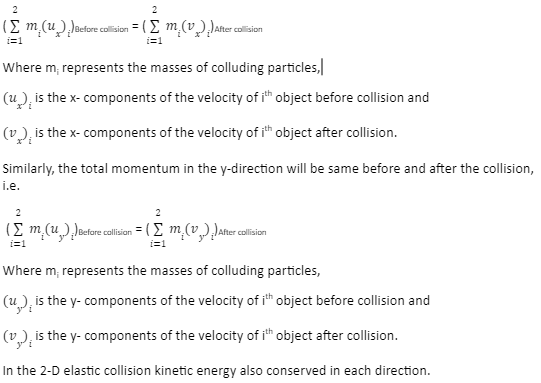
A collision occurs when one body collides with another. When two bodies collide, energy gets transferred from one to the other. The ability to conduct tasks is called energy. Its occurrence in physics is seen when particles, grouping of particles or solid entities move toward one another and get close enough to interact and exert a mutual effect. Additionally, some energy is often passed to the surrounding air in such impacts, causing the air to heat up and emit sound. Light also transports energy from one location to another. In terms of collision, both elastic collisions in one dimension and elastic collisions in two dimensions are quite important.



 Profile
 Settings
 Refer your friends
 Sign out