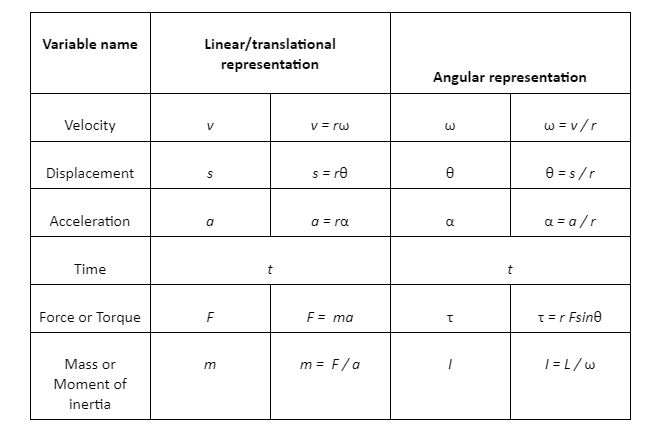
Angular variables are the physical values used to represent rotational or angular motion.
From the various examples of angular variables, let us take displacement as a variable to understand the concept of rotational motion. Linear motion is when concepts like displacement can be measured in a linear pattern from point A to B, on a straight line. Here, as opposed to linear motion, rotational motion uses rotational or angular variables to define the same on an angular surface where displacement is not linear, rather has an angular shift.
Angular velocity (ω), angular displacement (θ), and angular acceleration (α) are some examples of angular variables.
Translational motion and angular motion—variable representation
Angular displacement (θ)
The difference between the final angle of position and the initial angle of position is known as angular displacement. This displacement is noted on a circular or angular surface when there is a change in position from point A to point B, where both points lie at an angular distance from one another.
This is one of the most noted examples of angular variables and is represented by using the symbol ‘θ’.
θ = s / r
Here, ‘θ’ represents angular displacement,
‘s’ represents displacement,
and ‘r’ represents the radius of curvature.
The unit used for angular displacement is radian or degree.
Angular velocity (ω)
An object’s angular velocity determines how fast or slow it spins on a circular surface. Here, the motion is rotational and follows an angular spin instead of a linear movement.
Another one of the three most noted examples of angular variables is that angular velocity is represented by the symbol ‘ω’.
ω = v / r
Here, ‘ω’ represents angular velocity,
‘v’ represents velocity,
and ‘r’ represents the radius of curvature.
The unit used for angular velocity is radian per second or rad/s.
Note: While linear speed may change at different points, angular speed remains constant throughout the surface.
Angular acceleration (α)
Angular acceleration can best be understood in terms of linear acceleration. When divided by the change in time, the change in velocity makes for linear acceleration. Similarly, when velocity in the above equation or definition is substituted by angular velocity, it results in angular acceleration. This gives us a new definition for angular acceleration. Therefore, angular acceleration is the change in angular velocity divided by the change in time.
Angular acceleration is the third and final one among the most noted examples of angular variables and is represented by using the symbol ‘α’.
α = a / r
Here, ‘α’ represents angular acceleration,
‘a’ represents acceleration,
and ‘r’ represents the radius of curvature.
The unit used for angular acceleration is radian per second squared or rad/s2.
Angular velocity (ω), angular displacement (θ), angular acceleration (α), are three of the most noted angular variables examples and thus the foundational concepts of rotational motion. Other important terms as discussed above are position, period, frequency, torque, the moment of inertia.



 Profile
 Settings
 Refer your friends
 Sign out