Addition and subtraction are the two main arithmetic operations which teach us how to add and subtract two or more mathematical values (integers, fraction, etc.). The other two basic mathematical operations are Multiplication and division. Addition is denoted by the plus sign (‘+’) and subtraction is denoted by the negative sign (‘-‘) (minus sign).
Addition is defined as the sum of two or more numbers or values so that the result will be another number. Addition is denoted by a symbol (+).
When we add 3 and 6, then we get 9 as a result.
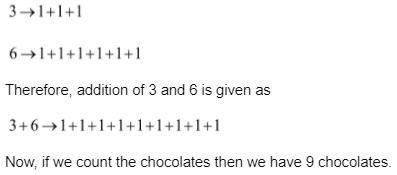
Let us understand the addition of 3 and 6 in a practical way.
Let, you have 3 chocolates and then you buy 6 more chocolates. How many chocolates do you have now after adding all the chocolate?
Sol. 3 and 6 can be written as
Subtraction is defined as the reduced value of two or more numbers or values so that the result will be another number (difference). Subtraction is denoted by a symbol (-).
When we subtract 6 and 3, then we get 3 as a result.
6-3 = 3
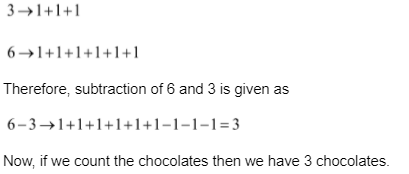
Let us understand the addition of 3 and 6 in a practical way.
Let, you have 6 chocolates and then you eat 3 chocolates. How many chocolates do you have now after eating the 3 chocolates?
Sol. 3 and 6 can be written as
Example of fact of addition and subtraction are given as
9+3 = 12
3+9 = 12
12-9 = 3
12-9 = 9
Certain numbers and facts are related or form a “family” of facts and there are three numbers only in each family. In the family of facts given above, the members are 9, 3 and 12. These are related as we can add two of the numbers together to get the third number.
9+12 = 12
We can also switch the order of the given number which is used to get a third number.
3+9 = 12
We know, subtraction is the inverse of addition.
Therefore, start the subtraction from the result of addition and one of the addends then the third number is,
12-9 = 3
And also
12-3 = 9
Addition and subtraction are two of the basic arithmetic operations and are therefore important to learn. These worksheets are designed to appeal to young minds. Addition and subtraction worksheets are a valuable resource for encouraging children’s conceptual understanding of these skills. They also come with a step-by-step solution key to explain concepts to the kids.
Addition and subtraction worksheets allow kids to easily understand the fluent concepts of addition and subtraction of multi-digit numbers. With the effective learning pattern of well-structured addition and subtraction worksheets, it is very suitable for kids to gain confidence. These math worksheets keep students engaged through multiple interactive activities and simulations. Kids can learn efficiently by solving several fun visual exercises which are available in these worksheets.
A fraction is a quantity which expresses a portion of the whole. We use fraction addition and subtraction in our daily lives without even realizing it.
Addition and subtraction are two primary arithmetic operations that also apply to fractions. In order to easily add and subtract fractions, it is important to understand whether the fractions have the same or different denominators, since in each case we are performing different steps. Matching these concepts when solving fractional addition and subtraction problems is an important criterion for getting the right answer.
Fraction is defined as a number which is in the form of numerator and denominator. Fraction is written in the form of .p/q
Here,
P = numerator
q = denominator
Bar between p and q is known as the fraction bar.
When the fractions have the same denominator then we need to simply add the numerator.
Let us consider two fractional numbers, 3/7 and 5/7
Now, we have to add these two numbers and both the numbers have the same denominator.
Therefore,
When the fractions have different denominators then
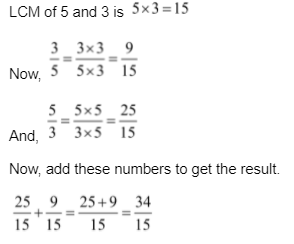
Let us consider two fractional numbers, 3/5 and 5/3
Now, we have to add these two numbers and both the numbers have different denominators.
Therefore, we need to find the LCM of 5 and 3
When the fractions have the same denominator then we need to simply subtract the nominator.
Let us consider two fractional numbers, 3/7 and 5/7
Now, we have to subtract these two numbers and both the numbers have the same denominator.
Therefore,
When the fractions have different denominators then
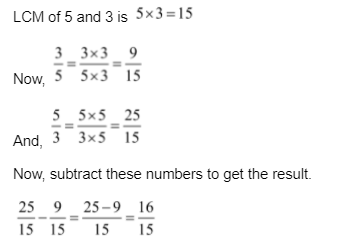
Let us consider two fractional numbers, 3/5 and 5/3
Now, we have to subtract these two numbers and both the numbers have different denominators.
Therefore, we need to find the LCM of 5 and 3
Addition and subtraction are the two main arithmetic operations which teach us how to add and subtract two or more mathematical values (integers, fraction, etc.).
Addition is defined as the sum of two or more numbers or values so that the result will be another number.
Subtraction is defined as the reduced value of two or more numbers or values so that the result will be another number (difference).
Fraction is defined as a number which is in the form of numerator and denominator.
Fraction is written in the form of .



 Profile
 Settings
 Refer your friends
 Sign out