Logic is the study of how to think logically. For example, to prove a theorem, we need to know how to evaluate the validity of a given argument.
A valid statement is a declarative phrase that is either true or untrue, but not both. Otherwise, it is referred to as an erroneous claim. Small letters, such as p, q, r, etc., indicate statements.
An open Statement of operation is a sentence that contains a variable that becomes a statement when specific values are assigned to the variable.
Compound statements are formed when two or more basic assertions are joined using words like “and,” “or,” “no,” “if,” “then,” and “if and only when.”
The truth values of a statement are represented by the letters T and F and indicate whether a statement is true or untrue.
All potential values for the variables occurring in a compound statement are listed in a truth table, which summarizes the truth values of the resultant assertions.
The term “tautology” refers to a compound assertion that is true regardless of the value of any of its constituent parts. Conversely, a contradiction is a compound assertion that is wrong for every one of its components (fallacy).
There are two essential symbols in this phrase.
It is possible to refer to a quantified statement as an “open sentence with a quantifier.”
It’s possible to use truth tables to determine if a statement has a logical fallacy or is true. A tautology is a statement that is true in every row of the table. It’s a contradiction if it’s false in every row. There must be at least one row where the statement is true and at least one row where it is untrue for the proposition to be a contingency.
In light of this, what do you think?
If violets are blue and roses are red, then violets must be red as well.
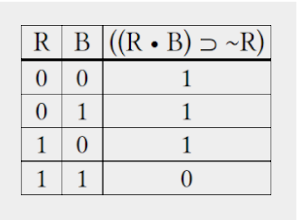
Even though this may seem to be a contradiction, it is accurate. However, when it comes to logical characteristics, our intuitions are frequently incorrect. So, to figure out what kind of proposition it is, let’s represent it and build a truth table for it:
A look at the truth table above reveals that the statement is not a contradiction. True in every row except the final one: there are more ways to be true than there are ways to be false. It’s a contingency since it’s true in one row and untrue in another.
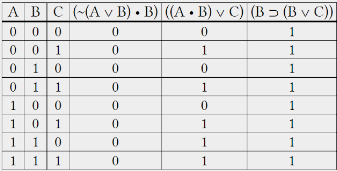
A few additional instances are in order. Here are the potential truth values for three compound propositions, as shown in the accompanying truth table. There is a tautology, a contradiction, and a contingency in each of these statements.
Is it possible to distinguish the difference?
Instead, we may utilize the truth assignment technique to assess if a claim is a tautology, contradiction, or contingency for a Statement of operation. As an alternative to creating a full truth table, we may verify whether the proposition is false and if it is conceivable for it to be false.
We have learnt about the Statement of operation. Truth-functional connectives cannot express the logical structure of certain propositions, and hence some tautologies and contradictions seem as if they are contingencies in propositional logic. In future chapters, we’ll cover a variety of logical structures.



 Profile
 Settings
 Refer your friends
 Sign out