We rationalize the denominator to make any calculation on the rational number easy. When we rationalize the denominator in a fraction, we are removing any radical expressions from the denominator, such as square roots and cube roots.
Rationalizing is the process of multiplying a surd by another surd of the same kind to produce a rational number. The rationalization factor is the surd that is utilized to multiply (RF).
Rationalizing the denominator is the process of transferring a root, such as a cube root or a square root, from the bottom to the top of a fraction denominator. In this approach, the fraction is reduced to its simplest form, and the denominator becomes rational.
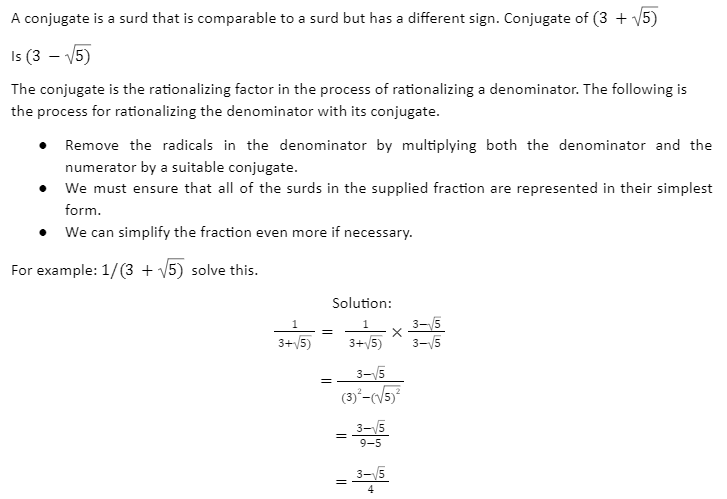
The following is the procedure for rationalizing the denominator:
The steps to rationalize the denominator using two terms are as follows:
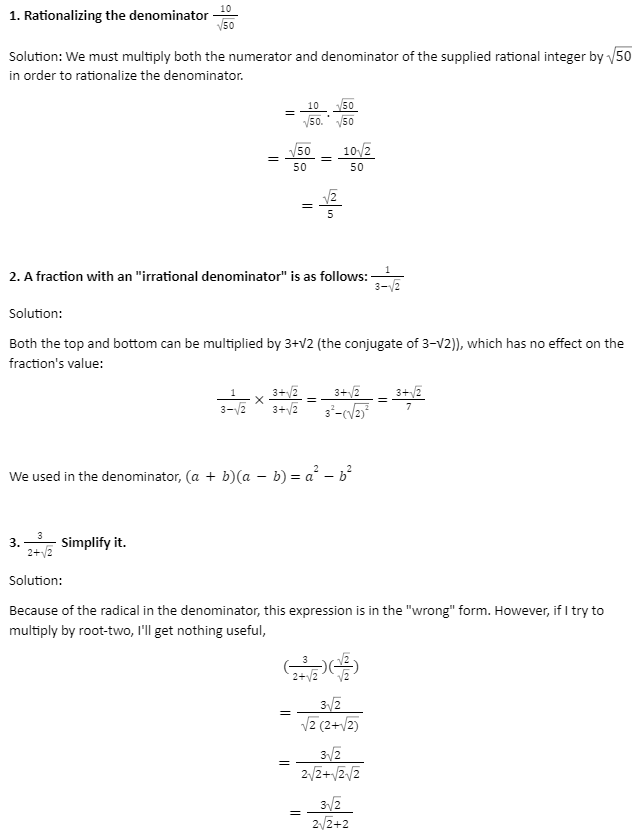
A sample of questions that may appear on the exam are given below.
We study that, Rationalization can be defined as the process of removing a radical or imaginary The denominator of an algebraic fraction is a number. To put it another way, remove the radicals in a fraction until the denominator is only a rational integer.
When you have a fraction with a radical in the denominator, you can eliminate the radical by using a technique called rationalizing a denominator. By removing radicals from the denominators, rationalizing a denominator makes it easier to understand what the quantity really is.



 Profile
 Settings
 Refer your friends
 Sign out