Access free live classes and tests on the app
Download
+
Unacademy
  • Goals
    • AFCAT
    • AP EAMCET
    • Bank Exam
    • BPSC
    • CA Foundation
    • CAPF
    • CAT
    • CBSE Class 11
    • CBSE Class 12
    • CDS
    • CLAT
    • CSIR UGC
    • GATE
    • IIT JAM
    • JEE
    • Karnataka CET
    • Karnataka PSC
    • Kerala PSC
    • MHT CET
    • MPPSC
    • NDA
    • NEET PG
    • NEET UG
    • NTA UGC
    • Railway Exam
    • SSC
    • TS EAMCET
    • UPSC
    • WBPSC
    • CFA
Login Join for Free
avtar
  • ProfileProfile
  • Settings Settings
  • Refer your friendsRefer your friends
  • Sign outSign out
  • Terms & conditions
  • •
  • Privacy policy
  • About
  • •
  • Careers
  • •
  • Blog

© 2023 Sorting Hat Technologies Pvt Ltd

JEE Main 2026 Preparation: Question Papers, Solutions, Mock Tests & Strategy Unacademy » JEE Study Material » Mathematics » Product Rule Formula Using the Chain Rule

Product Rule Formula Using the Chain Rule

We may get the product rule formula in calculus by viewing the product rule as a specific instance of the chain rule formula, which is derived from the chain rule formula. Given an x-valued differentiable function f(x), we can say that h(x) = f(x)g (x). As a result, it has been demonstrated.

Table of Content
  •  

Calculus employs the product rule to differentiate functions. The product rule is employed when a given function is the product of two or more other functions. If the issues are a combination of two or more functions, the Product Rule can be used to find their derivatives.Simply put, the term “product” refers to the combination of two functions that are multiplied together.

This rule, which was discovered by Gottfried Leibniz, allows us to calculate derivatives that we don’t want (or are unable to) multiply rapidly.

With another way of putting it, the product rule allows us to find the derivative of two differentiable functions that are multiplied together by combining our knowledge of both the power rule for derivatives and the sum and difference rule for derivatives.

It can be expressed as follows in simple terms: The second times the derivative of the first multiplied by the derivative of the first multiplied by the second times its own derivative equals the derivative of the second times its own derivative.

As a specific case of the chain rule, we can use it to get the calculus formula for the product rule we need. Make that f(x) can be differentiated, and the result is that h(x) equals f(x) .g (x).

ddx(f.g)=[(fg)/f][df/dx]+[(fg)/g][dg/dx]=g(df/dx)+f(dg/dx)

Hence proved.

Using chain rule and product rule together : 

The chain rule and the product rule can both be applied on the same derivative at the same time. We can see by now that these derivative rules are frequently employed in conjunction with one another. We’ve seen the power rule used in conjunction with both the product rule and the quotient rule, as well as the chain rule used in conjunction with the power rule.By combining simpler functions in one or more of the following methods, it is possible to generate several more complex functions from them:

Addition and subtraction: u(x) +v(x) and u(x)-v(x),

Multiplication and division: u(x)v(x) and u(x)v(x)

Composition: u(v(x)).

We should remember that there exist rules for differentiating functions that are produced in this manner, which is a good thing. The linearity of the derivative may be used for addition and subtraction; the product rule and the quotient rule can be used for multiplication and division; and the chain rule can be used for composition to simplify the process. Let’s take a look at these regulations again.

This means that, in addition to utilising these principles individually, it is also feasible to use them in conjunction with one another, which allows us to differentiate any combination of elementary functions. To be sure, this is not always a simple exercise, and it can be difficult at times to determine which rules should be applied and in what order, as well as whether there are any algebraic simplifications that will make the process easier to complete. To further understand the abilities required to navigate this landscape, we will look at a variety of cases in this explainer.

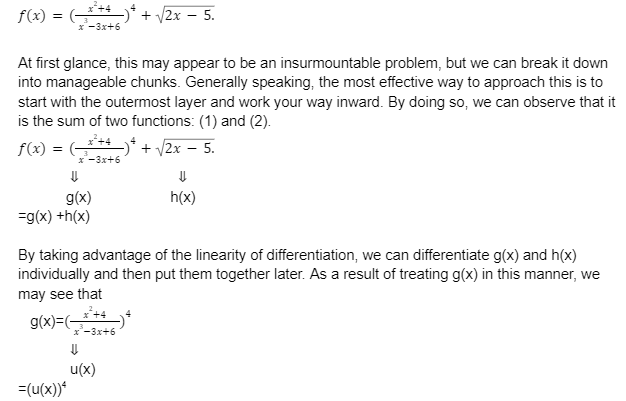
Examine a difficult function that incorporates many different processes, and how we might approach the differentiation by dividing it into smaller components to make it easier to understand. Consider the following scenario:

In other words, because g(x) is a collection of functions, we may use the chain rule to assist us distinguish between them. This, of course, necessitates the computation of the derivative of u(x), but even this task can be split down into smaller components. Continuing in this manner, we can continue to reduce layers of complexity from the function until we reach elementary expressions that we are familiar with and can discriminate. The following is a visual representation of what we mean.


Take note that all of the functions at the bottom of the tree are functions that we can clearly distinguish from one another. By using the necessary principles at each level, it is possible to find the derivatives of even the most difficult functions, as seen above.

We will now look at some examples in which we use this method, albeit to cases that are a little more straightforward. To begin, let us examine a factored high-degree polynomial function that has been factored several times.

Proof of chain rule : 

Conclusion : 

Calculus employs the product rule to differentiate functions. The product rule is employed when a given function is the product of two or more other functions. If the issues are a combination of two or more functions, the Product Rule can be used to find their derivatives.Simply put, the term “product” refers to the combination of two functions that are multiplied together.The chain rule and the product rule can both be applied on the same derivative at the same time. We can see by now that these derivative rules are frequently employed in conjunction with one another.


 
faq

Frequently Asked Questions

Get answers to the most common queries related to the IIT JEE Examination Preparation.

What is the best way to tell if it is the product rule or the chain rule?

Ans : Generally speaking, the chain rule is used when differentiating a so-called “function o...Read full

What is the purpose of the chain rule?

Ans : In order to calculate the derivative of a composition of functions, such as the composition f...Read full

What is the significance of the term "chain rule"?

Ans : The chain rule is so named because it is used to compute the derivative of composites of func...Read full

Who is credited with inventing the chain rule?

Ans : If you believe that counting numbers is similar to reciting the alphabet, take this quiz to s...Read full

Does the product rule take precedence over the chain rule?

Ans : First, apply the product rule to each term of the product, and then apply the chain rule to t...Read full

Ans : Generally speaking, the chain rule is used when differentiating a so-called “function of a function,” such as f(g(x)). Generally, we utilise the product rule when differentiating two functions that have been multiplied together, such as f(x)g(x). Consider the expression f(x) = sin (3x).


Ans : In order to calculate the derivative of a composition of functions, such as the composition f(g(x)) of the functions f and g, we must first determine what the composition of functions is.

Ans : The chain rule is so named because it is used to compute the derivative of composites of functions by chaining the derivatives of the composites of functions together.

Ans : If you believe that counting numbers is similar to reciting the alphabet, take this quiz to see how fluent you are in the language of mathematics. The chain rule has been known since the end of the 17th century, when Isaac Newton and Gottfried Leibniz discovered the calculus for the first time.


Ans : First, apply the product rule to each term of the product, and then apply the chain rule to the entire product.

Trending Topics

  • JEE Main 2024
  • JEE Main Rank Predictor 2024
  • JEE Main Mock Test 2024
  • JEE Main 2024 Admit Card
  • JEE Advanced Syllabus
  • JEE Preparation Books
  • JEE Notes
  • JEE Advanced Toppers
  • JEE Advanced 2022 Question Paper
  • JEE Advanced 2022 Answer Key
  • JEE Main Question Paper
  • JEE Main Answer key 2022
  • JEE Main Paper Analysis 2022
  • JEE Main Result
  • JEE Exam Pattern
  • JEE Main Eligibility
  • JEE College predictor
combat_iitjee

Related links

  • JEE Study Materials
  • CNG Full Form
  • Dimensional Formula of Pressure
  • Reimer Tiemann Reaction
  • Vector Triple Product
  • Swarts Reaction
  • Focal length of Convex Lens
  • Root mean square velocities
  • Fehling’s solution
testseries_iitjee
Predict your JEE Rank
.
Company Logo

Unacademy is India’s largest online learning platform. Download our apps to start learning


Starting your preparation?

Call us and we will answer all your questions about learning on Unacademy

Call +91 8585858585

Company
About usShikshodayaCareers
we're hiring
BlogsPrivacy PolicyTerms and Conditions
Help & support
User GuidelinesSite MapRefund PolicyTakedown PolicyGrievance Redressal
Products
Learner appLearner appEducator appEducator appParent appParent app
Popular goals
IIT JEEUPSCSSCCSIR UGC NETNEET UG
Trending exams
GATECATCANTA UGC NETBank Exams
Study material
UPSC Study MaterialNEET UG Study MaterialCA Foundation Study MaterialJEE Study MaterialSSC Study Material

© 2026 Sorting Hat Technologies Pvt Ltd

Unacademy
  • Goals
    • AFCAT
    • AP EAMCET
    • Bank Exam
    • BPSC
    • CA Foundation
    • CAPF
    • CAT
    • CBSE Class 11
    • CBSE Class 12
    • CDS
    • CLAT
    • CSIR UGC
    • GATE
    • IIT JAM
    • JEE
    • Karnataka CET
    • Karnataka PSC
    • Kerala PSC
    • MHT CET
    • MPPSC
    • NDA
    • NEET PG
    • NEET UG
    • NTA UGC
    • Railway Exam
    • SSC
    • TS EAMCET
    • UPSC
    • WBPSC
    • CFA

Share via

COPY