Access free live classes and tests on the app
Download
+
Unacademy's Blog!
Login Join for Free
avtar
  • ProfileProfile
  • Settings Settings
  • Refer your friendsRefer your friends
  • Sign outSign out
  • Terms & conditions
  • •
  • Privacy policy
  • About
  • •
  • Careers
  • •
  • Blog

© 2023 Sorting Hat Technologies Pvt Ltd

[wp_login_wall media_id="448945" text_before_login="Download JEE Maths Formulas" text_after_login="Download JEE Maths Formulas"]

Trending Topics

  • JEE Main 2024
  • JEE Main Rank Predictor 2024
  • JEE Main Mock Test 2024
  • JEE Main 2024 Admit Card
  • JEE Advanced Syllabus
  • JEE Preparation Books
  • JEE Notes
  • JEE Advanced Toppers
  • JEE Advanced 2022 Question Paper
  • JEE Advanced 2022 Answer Key
  • JEE Main Question Paper
  • JEE Main Answer key 2022
  • JEE Main Paper Analysis 2022
  • JEE Main Result
  • JEE Exam Pattern
  • JEE Main Eligibility
  • JEE College predictor
[wp_login_wall media_id="424566" text_before_login=" Download Previous Year Papers" text_after_login="Download Previous Year Papers"] combat_iitjee

Related links

  • JEE Study Materials
  • CNG Full Form
  • Dimensional Formula of Pressure
  • Reimer Tiemann Reaction
  • Vector Triple Product
  • Swarts Reaction
  • Focal length of Convex Lens
  • Root mean square velocities
  • Fehling’s solution
testseries_iitjee Predict your JEE Rank .
[wp_login_wall media_id="448945" text_before_login="Download JEE Maths Formulas" text_after_login="Download JEE Maths Formulas"]

Trending Topics

  • JEE Main 2024
  • JEE Main Rank Predictor 2024
  • JEE Main Mock Test 2024
  • JEE Main 2024 Admit Card
  • JEE Advanced Syllabus
  • JEE Preparation Books
  • JEE Notes
  • JEE Advanced Toppers
  • JEE Advanced 2022 Question Paper
  • JEE Advanced 2022 Answer Key
  • JEE Main Question Paper
  • JEE Main Answer key 2022
  • JEE Main Paper Analysis 2022
  • JEE Main Result
  • JEE Exam Pattern
  • JEE Main Eligibility
  • JEE College predictor
[wp_login_wall media_id="424566" text_before_login=" Download Previous Year Papers" text_after_login="Download Previous Year Papers"] combat_iitjee

Related links

  • JEE Study Materials
  • CNG Full Form
  • Dimensional Formula of Pressure
  • Reimer Tiemann Reaction
  • Vector Triple Product
  • Swarts Reaction
  • Focal length of Convex Lens
  • Root mean square velocities
  • Fehling’s solution
testseries_iitjee Predict your JEE Rank .
JEE Main 2026 Preparation: Question Papers, Solutions, Mock Tests & Strategy Unacademy » JEE Study Material » Mathematics » Parallelogram Law of Vector Addition
[wp_login_wall media_id="448945" text_before_login="Download JEE Maths Formulas" text_after_login="Download JEE Maths Formulas"]

Trending Topics

  • JEE Main 2024
  • JEE Main Rank Predictor 2024
  • JEE Main Mock Test 2024
  • JEE Main 2024 Admit Card
  • JEE Advanced Syllabus
  • JEE Preparation Books
  • JEE Notes
  • JEE Advanced Toppers
  • JEE Advanced 2022 Question Paper
  • JEE Advanced 2022 Answer Key
  • JEE Main Question Paper
  • JEE Main Answer key 2022
  • JEE Main Paper Analysis 2022
  • JEE Main Result
  • JEE Exam Pattern
  • JEE Main Eligibility
  • JEE College predictor
[wp_login_wall media_id="424566" text_before_login=" Download Previous Year Papers" text_after_login="Download Previous Year Papers"] combat_iitjee

Related links

  • JEE Study Materials
  • CNG Full Form
  • Dimensional Formula of Pressure
  • Reimer Tiemann Reaction
  • Vector Triple Product
  • Swarts Reaction
  • Focal length of Convex Lens
  • Root mean square velocities
  • Fehling’s solution
testseries_iitjee Predict your JEE Rank .

Parallelogram Law of Vector Addition

In vector theory, the parallelogram law of vector addition is a method for determining the sum of two vectors that are based on the parallelogram law of vector addition.

Table of Content
  •  

In vector theory, the parallelogram law of vector addition is a method for determining the sum of two vectors that is based on the parallelogram law of vector addition. We will look at two laws of vector addition – the triangle law of vector addition and the parallelogram law of vector addition – in this chapter. This law of vector addition is used to add two vectors when the vectors to be added form two adjacent sides of a parallelogram formed by combining the tails of the two vectors to produce the parallelogram itself. The diagonal of the parallelogram is used to calculate the sum of the two vectors in this case.

Throughout this article, we will look at the parallelogram law of the addition of vectors, including its formula and explanation, as well as examples of its application. We will study how to apply the law with the assistance of many instances in order to gain a better knowledge of the topic.

Parallelogram Law of Vector Addition

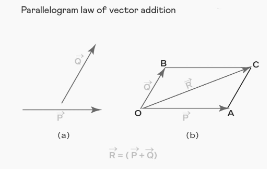
A vector addition operation can be used to determine the sum of two vectors, and the parallelogram law of vector addition is a law that makes it easier to determine the sum vector that results from the operation. Assume that a fish is swimming from one side of a river to the other side of the river in the direction of the vector Q, and that the river water is flowing in the direction of the vector P, as shown in the image below.

Since there are two velocities in play – that of the fish and the flow of water in the river (which will be a separate velocity) – the net velocity of the fish is the total of the two velocities. As a result, the fish will move in a different direction along a vector that is equal to the sum of the two velocities. The net velocity may now be calculated by considering these two vectors as the neighbouring sides of a parallelogram and applying the parallelogram law of vector addition to determine the resultant total vector.

h1

The Formula for the Parallelogram Law of Vector Addition

Consider two vectors P and Q that are at an angle of one another. The sum of the vectors P and Q is represented by the vector R, which is the resultant sum vector, when the parallelogram law of vector addition is applied to the vectors P and Q. If the resultant vector R forms an angle with the vector P, the following formulas can be used to calculate its magnitude and direction:

|R| = √(P2 + Q2+ 2PQ cos θ)

β = tan-1[(Q sin θ)/(P + Q cos θ)]

Proof of the Parallelogram Law of Vector Addition

First, let us look at the formal formulation of the parallelogram law of vector addition:

The following is a formal statement of the Parallelogram Law of Vector Addition: If two vectors can be represented completely by the two adjacent sides (both in magnitude and direction) of a parallelogram drawn from a point, then their resultant sum vector can be represented completely by the diagonal of the parallelogram drawn from that point.

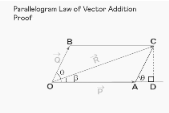
Then, in order to demonstrate the parallelogram law’s formula, we will use two vectors P and Q, which are represented by the two neighbouring sides OB and OA of the parallelogram OBCA, respectively, and represent the two adjacent sides of the parallelogram. The angle formed by the two vectors is denoted by the symbol. When these two vectors are added together, the consequent sum vector R is formed by drawing a diagonal from the same vertex O of the parallelogram to the opposite vertex O of the parallelogram, and the resultant sum vector R is formed by making an angle of with respect to the vector P.

h2

Extend the vector P until it intersects with the vector D so that CD is perpendicular to OD. Due to the fact that OB is parallel to AC, the angle AOB is equal to the angle CAD because they are matching angles, i.e., angle CAD =. In order to begin, we will first create a formula to determine the size of the resultant vector R. (side OC).

In right-angled triangle OCD, we have

OC² = OD² + DC²

⇒ OC² = (OA + AD)² + DC² — (1)

In the right triangle CAD, we have

cos θ = AD/AC and sin θ = DC/AC

⇒ AD = AC cos θ and DC = AC sin θ

⇒ AD = Q cos θ and DC = Q sin θ — (2)

Substituting values from (2) in (1), we have

R² = (P + Q cos θ)² + (Q sin θ)²

⇒ R² = P² + Q²cos2θ + 2PQ cos θ + Q²sin2θ

⇒ R² = P² + 2PQ cos θ + Q²(cos2θ + sin2θ)

⇒ R² = P² + 2PQ cos θ + Q² [cos2θ + sin2θ = 1]

⇒ R = √(P² + 2PQ cos θ + Q²) → Magnitude of the resultant vector R

Next, we will determine the direction of the resultant vector. We have in right triangles ODC,

tan β = DC/OD

⇒ tan β = Q sin θ/(OA + AD) [From (2)]

⇒ tan β = Q sin θ/(P + Q cos θ) [From (2)]

⇒ β = tan-1[(Q sin θ)/(P + Q cos θ)] → Direction of the resultant vector R

Important Points to Remember About the Parallelogram Law of Vector Addition

The parallelogram law of vector addition is used when two vectors are linked at their tails to form the adjacent sides of a parallelogram. When the two vectors are parallel, the magnitude of the resultant vector can be calculated by simply combining the magnitudes of the two vectors in the same direction.


The triangle law of vector addition and the parallelogram law of vector addition are equal, and the resultant vector has the same value as the original vector.

Conclusion

A vector addition operation can be used to determine the sum of two vectors, and the parallelogram law of vector addition is a law that makes it easier to determine the sum vector that results from the operation. Consider two vectors P and Q that are at an angle of one another. The sum of the vectors P and Q is represented by the vector R, which is the resultant sum vector when the parallelogram law of vector addition is applied to the vectors P and Q.If two vectors can be represented completely by the two adjacent sides (both in magnitude and direction) of a parallelogram drawn from a point, then their resultant sum vector can be represented completely by the diagonal of the parallelogram drawn from that point. When the two vectors are parallel, the magnitude of the resultant vector can be calculated by simply combining the magnitudes of the two vectors in the same direction.

faq

Frequently asked questions

Get answers to the most common queries related to the IIT JEE Examination Preparation.

What is the parallelogram law of vector addition in vector algebra?

Ans. This law of vector addition is used to add two vectors when the vectors ...Read full

What is the parallelogram law of vector addition formula?

Ans. The sum of the vectors P and Q is represented by the vector R, which is ...Read full

Is it necessary to employ the parallelogram law of vector addition?

Ans. Whenever it is necessary to determine the sum of two vectors, the Parallelogram Law of Vector Addition is emplo...Read full

What is the parallelogram law of vector addition and how do I use it?

Ans. Assuming that two vectors can be represented entirely by two neighbouring sides (both in magnitude and directio...Read full

How should the resultant vector be represented in the parallelogram law of vector addition?

Ans. If you use the parallelogram law of vector addition, the resultant vecto...Read full

Ans. This law of vector addition is used to add two vectors when the vectors to be added form two adjacent sides of a parallelogram formed by combining the tails of the two vectors to produce the parallelogram itself. The diagonal of the parallelogram is used to calculate the sum of the two vectors in this case.

Ans. The sum of the vectors P and Q is represented by the vector R, which is also known as the resultant sum vector. If the resultant vector R forms an angle with the vector P, the following formulas can be used to calculate its magnitude and direction:

|R| = √(P² + Q²+ 2PQ cos θ)

β = tan-1[(Q sin θ)/(P + Q cos θ)]

Ans. Whenever it is necessary to determine the sum of two vectors, the Parallelogram Law of Vector Addition is employed.

Ans. Assuming that two vectors can be represented entirely by two neighbouring sides (both in magnitude and direction) of a parallelogram formed from a point, then the consequent sum of the two vectors can be represented entirely by a diagonal of the parallelogram drawn from the same point.

Ans. If you use the parallelogram law of vector addition, the resultant vector is supplied by the sum of the two vectors in the equation. Its magnitude and direction are determined by the following:

|R| = √(P²+ Q²+ 2PQ cos θ)

β = tan-1[(Q sin θ)/(P + Q cos θ)]

Trending Topics

  • JEE Main 2024
  • JEE Main Rank Predictor 2024
  • JEE Main Mock Test 2024
  • JEE Main 2024 Admit Card
  • JEE Advanced Syllabus
  • JEE Preparation Books
  • JEE Notes
  • JEE Advanced Toppers
  • JEE Advanced 2022 Question Paper
  • JEE Advanced 2022 Answer Key
  • JEE Main Question Paper
  • JEE Main Answer key 2022
  • JEE Main Paper Analysis 2022
  • JEE Main Result
  • JEE Exam Pattern
  • JEE Main Eligibility
  • JEE College predictor
combat_iitjee

Related links

  • JEE Study Materials
  • CNG Full Form
  • Dimensional Formula of Pressure
  • Reimer Tiemann Reaction
  • Vector Triple Product
  • Swarts Reaction
  • Focal length of Convex Lens
  • Root mean square velocities
  • Fehling’s solution
testseries_iitjee
Predict your JEE Rank
.

Trending Topics

  • JEE Main 2024
  • JEE Main Rank Predictor 2024
  • JEE Main Mock Test 2024
  • JEE Main 2024 Admit Card
  • JEE Advanced Syllabus
  • JEE Preparation Books
  • JEE Notes
  • JEE Advanced Toppers
  • JEE Advanced 2022 Question Paper
  • JEE Advanced 2022 Answer Key
  • JEE Main Question Paper
  • JEE Main Answer key 2022
  • JEE Main Paper Analysis 2022
  • JEE Main Result
  • JEE Exam Pattern
  • JEE Main Eligibility
  • JEE College predictor
combat_iitjee

Related links

  • JEE Study Materials
  • CNG Full Form
  • Dimensional Formula of Pressure
  • Reimer Tiemann Reaction
  • Vector Triple Product
  • Swarts Reaction
  • Focal length of Convex Lens
  • Root mean square velocities
  • Fehling’s solution
testseries_iitjee
Predict your JEE Rank
.
Company Logo

Unacademy is India’s largest online learning platform. Download our apps to start learning


Starting your preparation?

Call us and we will answer all your questions about learning on Unacademy

Call +91 8585858585

Company
About usShikshodayaCareers
we're hiring
BlogsPrivacy PolicyTerms and Conditions
Help & support
User GuidelinesSite MapRefund PolicyTakedown PolicyGrievance Redressal
Products
Learner appLearner appEducator appEducator appParent appParent app
Popular goals
IIT JEEUPSCSSCCSIR UGC NETNEET UG
Trending exams
GATECATCANTA UGC NETBank Exams
Study material
UPSC Study MaterialNEET UG Study MaterialCA Foundation Study MaterialJEE Study MaterialSSC Study Material

© 2026 Sorting Hat Technologies Pvt Ltd

Unacademy's Blog!

Share via

COPY