The rule of sines provides the link between an oblique triangle’s sides and angles (non-right triangle). In trigonometry, the law of sines and the law of cosines are critical laws for “solving a triangle.” The sine rule states that the ratios of a triangle’s side lengths to the sine of its opposing angles are equal.
The ratio of a triangle’s side and matching angle is equal to the diameter of the triangle’s circumcircle. As a result, the sine law may be expressed as
a/sinA = b/sinB = c/sinC = 2R.
The law of sines is used to calculate the lengths of a triangle’s sides in relation to the sines of consecutive angles. It is the ratio of the length of the triangle’s side to the sine of the angle created by the remaining two sides. The law of sines formula is applicable to all triangles except the SAS and SSS triangles.
It states that a/sin A = b/sin B = c/sin C, where a, b, and c are the triangle’s lengths and A, B, and C are the triangle’s angles.
This formula may be expressed in three ways:
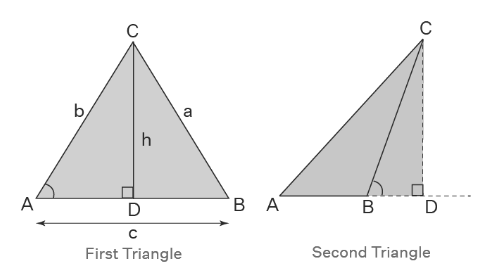
Given two angles and aside, the law of sines is used to calculate the remaining sides of a triangle. This is referred to as triangulation. Additionally, it may be used when given two sides and one of the non-enclosed angles. However, in certain of these circumstances, referred to as the ambiguous case, the triangle cannot be established uniquely using the available data, and we have two alternative values for the enclosed angle. To demonstrate the sine law, consider the following two oblique triangles.
In the first triangle we have: h/b = sinA
⇒ h = b sinA
In the second triangle we have: h/a = sinB
⇒ h = a sinB
Additionally, sin(180o – B) = sinB.
By equating the h values in the preceding formulas, we obtain:
a sinB = b sinA
⇒ a/sinA = b/sinB
Likewise, we can infer a relationship between sin A and sin C.
asinC = csinA
⇒ a/sinA = c/sinC
By combining the two formulas above, we obtain the sine law shown below.
a/sinA = b/sinB = c/sinC
The law of sines is useful for determining the missing side or angle of a triangle when all other necessary data is available. The sine law may be used to determine the following:
Both the law of sines and the law of cosines are used to determine an unknown angle or side of a triangle. Let us examine the distinction between the two laws.
It is utilized when we are given two angles and a side, or when we are given two sides and an included angle.
It is employed when we are given three sides or two sides plus an angle.
When two angles and a side are known, the rule of sines may be used to compute the remaining sides of a triangle—a process known as triangulation. Additionally, it may be employed when two sides and one of the open angles are known.



 Profile
 Settings
 Refer your friends
 Sign out