The possible values of an unknown that can satisfy the equation are called a general solution of the trigonometric equation. To find a complete solution we find all the possible values satisfying the equation. When we try to solve a trigonometric solution, we try to find all sets of values for θ to satisfy the equation. This study material focuses on the basics of trigonometry and the general solution of trigonometric equations.
The trigonometric equation has more than one trigonometric function of a variable at an unknown angle. A trigonometric equation is different from trigonometric identities. An identity is satisfied for every value of an unknown angle, while a trigonometric equation satisfies only some particular value of an unknown angle. The value of an unknown angle that satisfies the given equation is called the root of the equation.
For example, cos θ=½, the root for θ= 30 degrees or θ= 300 degrees, the equation is only satisfied if we put these values. When a value of the unknown angle is satisfied in a trigonometric equation is called its solution.
Since all trigonometric ratios have periods, the trigonometric equation has more than one solution or an infinite solution. There are three types of solutions. They are
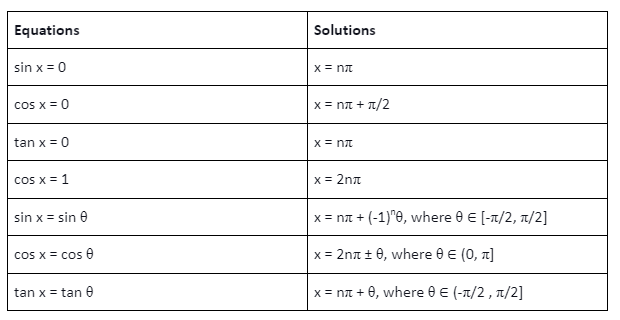
Here are some general equations along with their solutions.
For example, If tanθ +tan 2θ = tan 3θ tanθ tan 2θ tan 3θ, then what is the general value for θ?
Tan θ + tan 2θ + tan 3θ = tan θ tan 2θ tan 3θ
Tan 6θ = (tan θ +tan 2θ + tan 3θ – tan θ tan 2θ tan 3θ) / 1- ∑tan θ tan 2θ
= 0, ( from the given condition)
6θ = nπ =θ= nπ/6
So, the general value for θ is nπ/6.
For instance, we have to find the principal value for sin θ is -½. Since sin θ is negative, θ will be in the 3rd and 4th quadrant. We can approach these quadrants in two ways.
The principal value will never be greater than π. The principal value lies in the first rotation. Draw a trigonometrical circle and mark the quadrants. Select the direction, clockwise for the first and second quadrant and anticlockwise for the third and fourth. Select the numerically least angle. In case, there are two angles with a positive and negative sign, then the convention is to select the angle with a positive sign as principal value.
Lastly, the periodicity of the trigonometric function has an infinite number of positive and negative angles that satisfy the equation. Sin and cos have a period of 360 degrees, and tan has a period of 180 degrees. The process of solving general trigonometric equations is not clear. There are no rules that will help us achieve the solution. This procedure involves the usage of identities, algebraic manipulation and trial and error. Not all equations have solutions, but for those who do, can be solved using appropriate identities and algebraic manipulation.



 Profile
 Settings
 Refer your friends
 Sign out