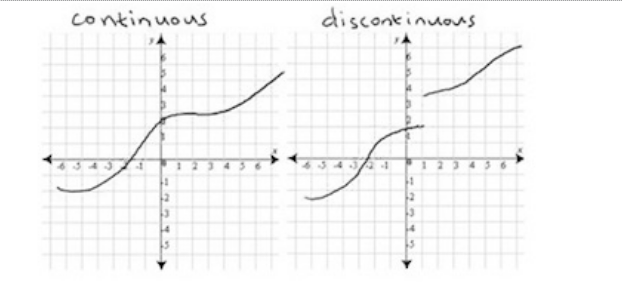
If a function is not continuous, it is called a discontinuous function in algebra. A discontinuous function also has a discontinuous curve, as a continuous function does. In other terms, we can state that the curve of a discontinuous function can’t be drawn with a single stroke of a pen, i.e., we must take up the pen at least once before the curve is complete. At at least one point, a discontinuous function contains breaks/gaps on its graph, and hence in its range.
Let’s look at the definition and graph of a discontinuous function, as well as the different forms of discontinuous functions. To help you understand, we’ll look at a few examples of discontinuous functions.
A continuous function is one in which a continuous modification of the argument (that is, a change without a jump) causes a fluctuation of the function’s value.
Contrastingly, a discontinuous function is an algebraic function that has a position where either the function is not specified at that point, or the function’s left and right limits are equal but not equal to the function’s value at that point, or the function’s limit does not exist at that point.
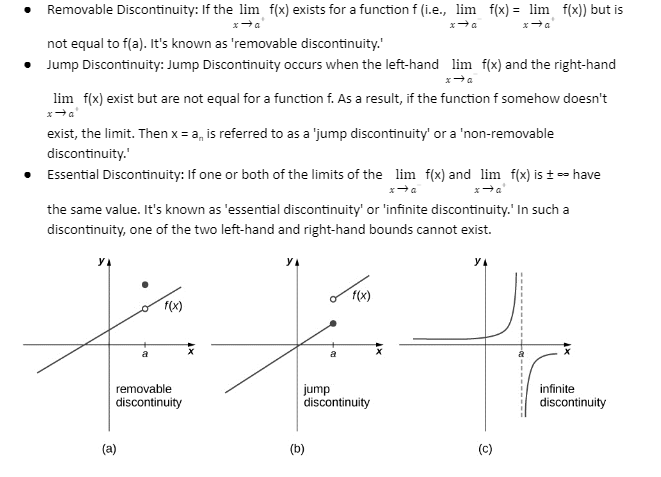
There are three sorts of discontinuities in discontinuous functions: removable, essential, and jump discontinuities. A graph of a discontinuous function contains gaps. In other words, if a function is not complete, it is referred to as a discontinuous function. The graphs of discontinuous functions contain holes or leaps in them.
In the following instances, f is a function that is regarded to be a discontinuous function at the point x = a:
f(x) = 1/(x – 2)
f(x) = tan x
f(x) = x2 – 1, for x < 1 and f(x) = x3 – 5 for 1 < x < 2
A discontinuous function’s graph cannot be drawn with a pen without uplifting it. When we put the pen on paper to draw a graph of a discontinuous function, we must take it up at least once more until the curve is finished and then continue to draw. On the curve of a discontinuous function, there are breaks or gaps. As a result, a discontinuous function’s range has at least one gap. By detecting where the graph breaks and contains a hole or a leap, we can recognize a discontinuous function. The graph of a discontinuous function associated with the various forms of discontinuities will be shown in the following section.
Now that we know what a discontinuous function is, let’s look at the numerous types of discontinuities that can occur in a function:



 Profile
 Settings
 Refer your friends
 Sign out