The derivative meaning of function in calculus is the mathematics of continuous change or the rate of change of a quantity concerning another. We can find the derivative at every point for a given function f in x, i.e., f(x). It simply means it is a function f concerning x. The function f changes the input into an output. If we take out the derivative of this function, then the function f will change to f’, df/dx, or f’ (x). As we perform different operations on numbers likewise, we can define algebra as function derivatives, such as sum, difference, product, and quotient.
A determinant refers to an element that determines or identifies the value or nature of something.
In equations, the determinant is a price related to a rectangular matrix. It may be computed from entries of the matrix via means of a selected mathematics expression, proven below:
For a 2×2 matrix, [a b]
[c d]
the determinant will be; ad- bc
In the equation, the cofactor d, referred to as an adjunct, interprets a selected creation that helps compute each determinant of rectangular matrices and the inverse of rectangular matrices. The cofactor of the (i,j) access of a matrix, also called the (i,j) cofactor of a matrix, is the smallest of that access. The cofactor and access of a matrix is described as:
Cij= (-1)i+jMij
Dependents received through casting off barely one row and one column from rectangular matrices (main minors) are compelled for calculating matrix cofactors. Let A be an m× n matrix and k a number with 0<k≤m and k ≤ n. A k × k small of A is the determinant of a k×k matrix obtained from A by eliminating m−k rows and n−k sections.
det I = 1;
To conduct column and row operations on determinants, use the following rules:
Determinants, commonly categorised as first-order determinants, second-order determinants, and third-order determinants, provide a similar formula to find a solution to a system of n equations in n unknowns. This article discusses various formulas and methods of differentiation of determinants. Differentiation is finding out the rate of change of a parameter. The rate of change of a parameter is known as its derivative.
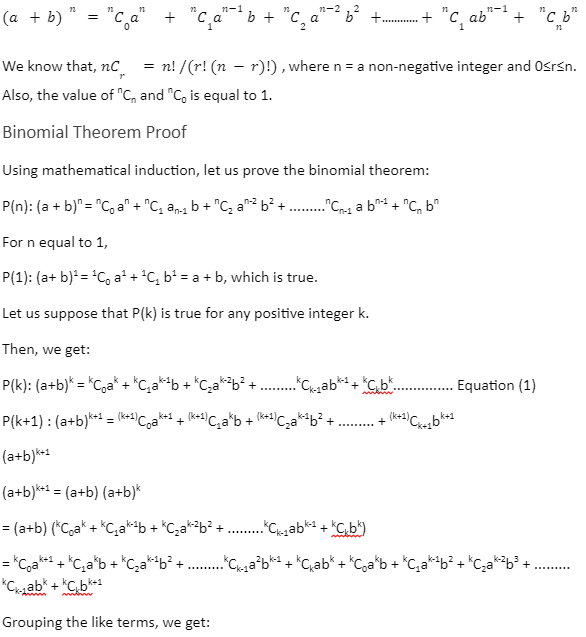
According to the binomial theorem, the total number of terms in an expansion is always more than the index. Take, for example, an expansion of (a + b)n with n+1 terms and n as the index of the equation (a + b)n, where n is any positive integer.
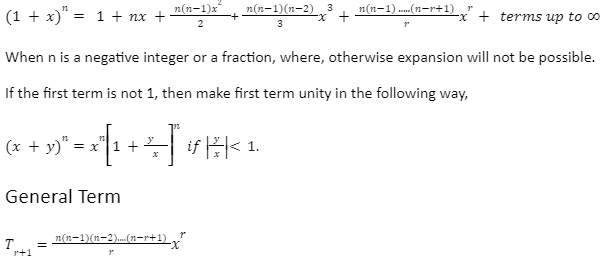
The binomial theorem can be used to extend (x + y)n, where n is any rational number. Let’s look at the binomial theorem for positive integral indices.
The binomial theorem is a rule that can be used to enlarge any power of a binomial.
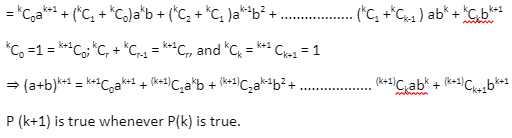
Therefore, P(n) is true for all positive integral values of n.
The binomial coefficients are the figures associated with the variables x, y, in the expansion of (x +y)n. The binomial portions are represented as nC0, nC1, nC2. The binomial coefficients are attained through the Pascal triangle or by using the combinations formula.
The binomial expansion has more application than algebra II. In statistics, it is used to calculate the binomial distribution.
This allows statisticians to quantify the risk of a certain number of positive results in a set of trials.
Binomial expansion is also intriguing from a fine perspective as it allows mathematicians to gain insight into the properties of polynomials.
Binomial developments are used in numerous numerical and logical calculations, including kinematic and gravitational time enlargement, active energy, electric quadrupole post and determining the relativity factor gamma, to mention a few.
The number of terms in a binomial expansion of a binomial articulation raised to some power is another factor of the binomial development.



 Profile
 Settings
 Refer your friends
 Sign out