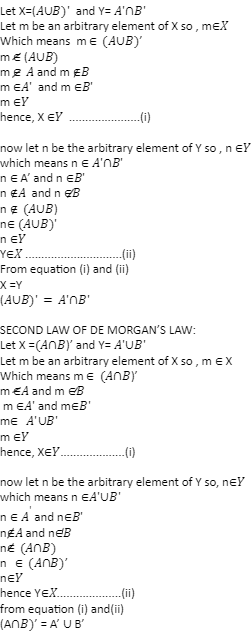
They are named after Augustus De Morgan , a British mathematician in the 19th century. The set of all those elements which are either in A or in B is the union of two sets A and B.
In other we can say that the complement of union of two sets is intersection of their complement.we can also call in de morgan’s laws on the union. The mathematical representation of de morgan’s laws on union is:
(A∪B)’=A’∩B’
Further in this article we will do the proof of this law by venn diagram as well as by written.
And also take some questions related to this topic to understand this more easily and fast.
STATEMENT OF DE MORGAN’S LAW THEOREM IN SET THEORY
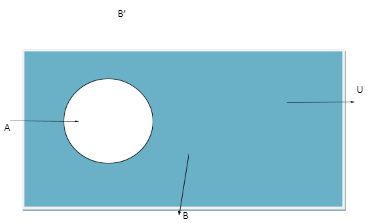
Let two sets be A and B and their complements be A’ And B’ .
First law of De morgan’s says that the union of complement of the two sets A and B is equal to the intersection of their separate complements.
(A∪B)’=A’∩B’
Second law of De morgan’s says that the complement of the intersection of two sets A and B is equal to the union of their separate complements.
(A∩B)’ = A’ B’
DE MORGAN’S LAW PROOF IN SET THEORY
FIRST LAW OF DE MORGAN’S LAW:
DE MORGAN’S LAW ON UNION IN SET THEORY
This Is also known as the first law of de Morgan’s theorem which says that the union of complement of the two sets A and B is equal to the intersection of their separate complements.
(A∪B)’=A’∩B’
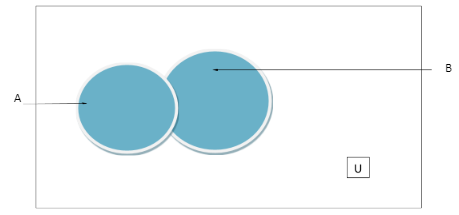
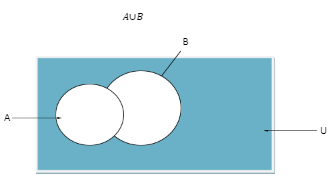
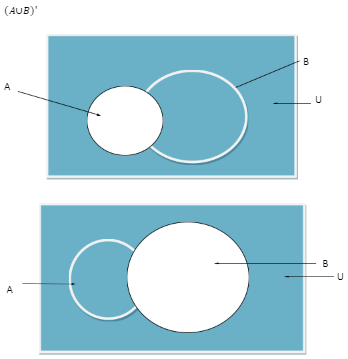
PROOF OF DE MORGAN’S LAW ON UNION BY VENN DIAGRAM
PROVING (A∪B)’=A’∩B’
(A∪B)’
Therefore (A∪B)’=A’∩B’
EXAMPLE OF DE MORGAN’S LAW ON UNION
Example 1 :- Let the universal set U={2,3,4,5,12,13,17}
The two subset A={12,13,17}
B={2,3}
(A∪B)= {2,3,12,13,17}
(A∪B)’={4,5}
A’ = {2,3,4,5}
B’ = {4,5,12,13,17}
A’B’={4,5}
Therefore (A∪B)’=A’∩B’
Example 2 :- Let the universal set U={1,2,4,5,6,7}
The two subset A={5,6,7}
B={1,2}
(A∪B)= {1,2,5,6,7}
(A∪B)’={4}
A’ = {1,2,4}
B’ = {4,5,6,7}
A’B’={4}
Therefore (A∪B)’=A’∩B’
CONCLUSION
In this article we learn the de morgan’s theorem statement and its proof in set theory and our main focus in on the de morgan’s law on union we talk about the statement of
de morgan’s law on union and its proof by venn diagram and also do some examples so that it will clear better and solve some questions based on de morgan’s law on union.



 Profile
 Settings
 Refer your friends
 Sign out