Continuity and differentiability are important topics that students should know. To understand these topics in a better way, we will first see the definition of both Continuity and Differentiability.
In mathematics, Continuity is the conceptual model of the intuitive idea of a curve that develops without unexpected breaks or leaps. In calculus, differentiability is a one-variable function whose derivative exists at every point in its area.
Let us learn more about Continuity and Differentiability in detail by learning them separately.
In mathematics, a continuous function is one in which a continuous variation in the argument, such as no gap or leap, causes a continuous variation in the function’s value. This signifies that there are no discontinuities or abrupt changes in value. A function is continuous if it can guarantee indefinitely minor changes in its value by restricting its argument to sufficiently small changes.
Continuity is a fundamental idea in calculus and mathematics, where real and complex numbers are used as inputs and values of functions. The concept has been extended to include functions between metric and topological spaces. The latter is the most basic continuous function, and topology is founded on their formulation.
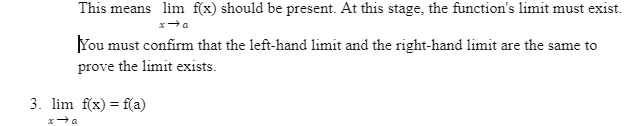
Three conditions must be fulfilled for a function f(x) to be called continuous. They are as follows:
Finally, at this stage, the limit must equal f(x).
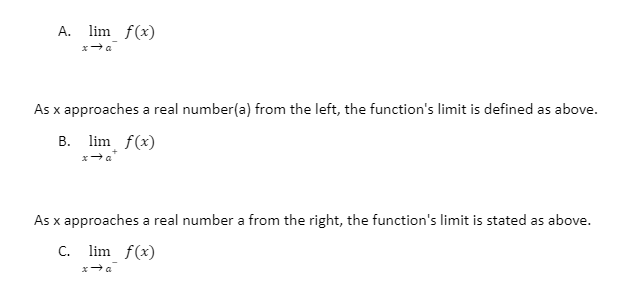
A function’s limit is the y-value that a function approaches as a graph approaches an x-value. There are limits to Continuity:
We say the limit of the function as x approaches an occurs and is equivalent to the one-sided limits if the left and right limits exist (are not infinite) and are equal. Then this is how we write it.
If the conditions are not met, then there will be discontinuity. A discontinuous function is a graph function that is not connected to other graph functions. There are three types of discontinuities:
In calculus, a differentiable function is a one-variable function whose derivative exists at every point in its domain. At each interior point in a differentiable function’s domain, the tangent line to the graph is always non-vertical. There is no break, crest, or angle in a differentiable function. A differentiable function is always continuous; however, not every continuous function is differentiable.
Differentiation is essential, and being able to assess whether or not a function is differentiable is a crucial skill. The derivative of a function is sometimes referred to as the “instantaneous rate of change” since it measures the rate of change of the function value concerning its input.
Rules for differentiating functions:
If f and g are differentiable functions, we may compute the derivatives of their sum, difference, product, and quotient using some rules. Here are various differentiability formulas for finding a differentiable function’s derivatives:
The condition of differentiability is more powerful than the criterion of Continuity. If f can be differentiated at x=a, it can also be continuous at x=a. The opposite, on the other hand, does not have to be true.
The only requirement for f’s continuity at x=a is that f(x)-f(a) converges to zero as x→ a.
That difference must converge even after being divided by x-a to be differentiable. To put it



 Profile
 Settings
 Refer your friends
 Sign out