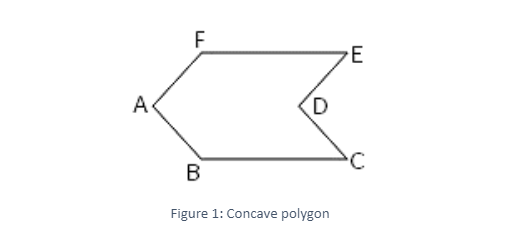
A concave polygon is one that has one or more interior angles larger than 180 0. It appears that a vertex has been ‘pushed in’ towards the polygon’s interior. It’s worth noting that a triangle (3-gon) can’t be concave. The opposite of a convex polygon is a concave polygon. A concave polygon is one with at least two sides that appear to be pushed inwards.. A concave polygon, for example, is a star.
A convex polygon is one that is not concave. A concave polygon has an uneven shape. Inside a polygon, the sum of angles might be anything. It can also be greater than 360 °. As a result, a reflex angle must exist within a concave polygon. The polygon can be built in both an inward and outward direction.
Because the sum of the angles of a three-sided polygon, i.e., a triangle, is already 180 degrees, it will not result in any concave polygon. We also need one angle greater than 180 ° for a concave polygon. As a result, a triangle isn’t a concave polygon.
A concave polygon is a non-convex polygon. If at least one of the internal angles of a simple polygon is bigger than, it is concave.”
Regular concave polygon: All sides of a regular concave polygon are equal, and all internal angles are equal. One of the angles of a concave polygon must be more than or equal to 180 degrees, according to the definition.
In addition, the total of angles inside a polygon equals (n – 2) x 180 °, where n is the number of sides.
We can deduce from this that this criterion cannot be met under any circumstances. A concave polygon with all sides equal and all angles equal is impossible. As a result, there is no such thing as a regular concave polygon.
Irregular concave polygon: Irregular polygons are easy to find. The sides and angles of irregular polygons can vary in number. Only the condition of concavity, i.e., one angle should be reflex, must be present. In an irregular concave polygon, the sum of inner angles has different units. Finally, concave polygons are all irregular polygons.
A concave polygon is one that has at least one angle greater than 180 °.
There are six inner angles in the hexagonal form, namely ∠ABC, ∠BCD, ∠CDE, ∠DEF, ∠EFA and ∠FAB. ∠CDE is more than 180° among the six internal angles.
The properties of a concave polygon are as follows:
Like other polygons, a concave polygon has inner and exterior angles. The important thing to remember about concave polygons is that one or more internal angles form a reflex angle, giving it the appearance of a concave polygon. To put it another way, the reflex angle causes the vertex to point inwards, giving it a distinctive shape. Let’s learn more about the sum of a concave polygon’s outer and interior angles.
A concave polygon’s outside angles add up to 360°. This means that, like all other polygons, the exterior angles of all concave polygons always add up to 360°.
The same formula that is used to get the sum of interior angles of other convex polygons is used to find the sum of interior angles of a concave polygon. The sum of internal angles equals (n – 2) 180°, where ‘n’ the number of sides of the polygon is.
In this article, we will learn A polygon that has at least one interior angle greater than 180 degrees is called a concave polygon. There must be at least four sides to it. The concave polygon’s shape is frequently uneven. A non-convex polygon is called a concave polygon. A convex polygon is the polar opposite of this polygon. Polygons play a significant role in students’ education because they teach them how to create patterns, tessellations, how to use polygons to create other shapes, how to build 3D shapes out of polygons, and about symmetry.



 Profile
 Settings
 Refer your friends
 Sign out