An auxiliary circle is a circle of an ellipse mainly determined by the diameter of the major axis and the equation of the ellipse is determined by the variable, i.e., x and y. The equation of a circle is x2+ y2 is equal to a2. Here we will also see one main problem related to the auxiliary circle. Generally, The equation gets formed by dividing the x variable with a and the y variable with b. And both are equal to 1. I.e. x2/a2 + y2/b2 = 1.
An auxiliary circle is a circle of an ellipse mainly determined by the diameter of the major axis.
The chief circle is the locus of the place of the crossing point of sets. And it has opposite digressions to an oval.
Two opposite digressions of circle x2/a2 + y2/b2 are always equal to 1
Whereas y – mx = √(a2m2+b2)
And, my + x = √(a2+b2 m2)
To acquire the locus of the mark of convergence y – mx = √(a2m2+b2) and my + x = √(a2+b2 m2)
mx = √(a2m2+b2) and my + x = √(a2+b2 m2)
, we get
(y – mx)2 + (my + x)2 = (a2m2 + b2) + (a2 + b2m)
⇒ x2 + y2 = a2 + b2, which is the condition of the chief circle.
The Auxiliary circle of a hyperbola has a cross-over pivot as the distance across. The endpoints of the cross-over pivot are the two vertices of the hyperbola, so the circle contains the two vertices of the hyperbola.
The condition of Auxiliary circle adversary a hyperbola is given by x
x2 + y2 = a2
We will see whether both terms, i.e., ellipse & circle, are different. When we talk about a circle, it is a shut-bent shape that is levelled. All around, the distance is similar from the focal point of the circle.
Here we will see some main problems related to the auxiliary circle.
Question: Find the condition to the helper circle of the oval 4x²+ 9y² – 24x – 36y + 36 = 0.
Solution:
4x²+ 9y² – 24x – 36y + 36 = 0
4 (x² – 6x + 9) + 9 (y² – 4y + 4) = 36
(x−3)29+(y−2)24=1.
The oval community is (3, 2)
if the length of the significant hub of the oval be 2a, a² = 9 ⇒ a = 3
x² + y² = a²
x² + y² = 3²
We see that an ellipse is similar to a parabola and hyperbola. The ellipse’s main feature, known as the latus rectum, is the central harmony that is seen opposite to the significant pivot. And the Foci S is always equal to the (ae, 0) and S’ is equal to the (- ae, 0). The equation of an ellipse is determined by the x2 /a2 with the addition of y2 /b2 . These both terms are always equal to the 1 i.e. x2 /a2 + y2 /b2 = 1. The eccentricity always ranges from points 0 and 1
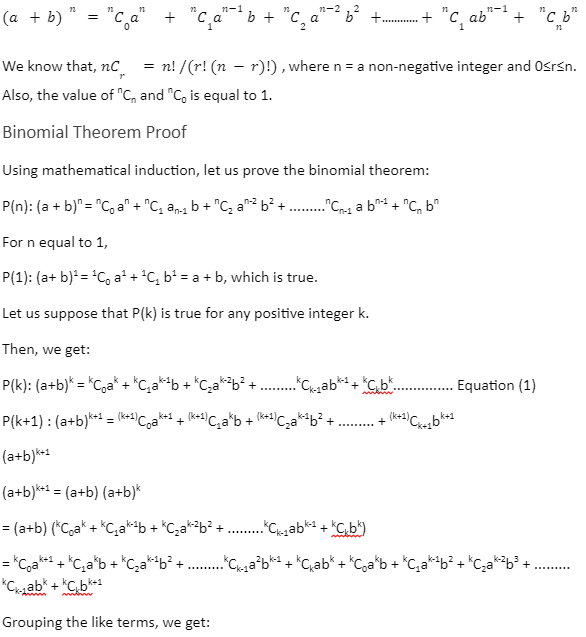
According to the binomial theorem, the total number of terms in an expansion is always more than the index. Take, for example, an expansion of (a + b)n with n+1 terms and n as the index of the equation (a + b)n, where n is any positive integer.
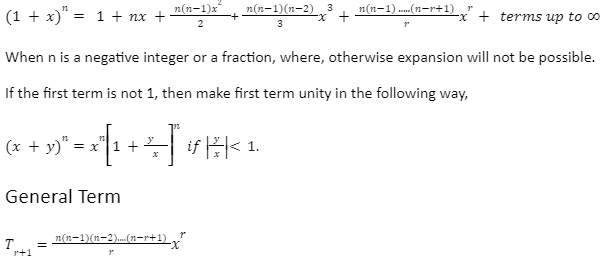
The binomial theorem can be used to extend (x + y)n, where n is any rational number. Let’s look at the binomial theorem for positive integral indices.
The binomial theorem is a rule that can be used to enlarge any power of a binomial.
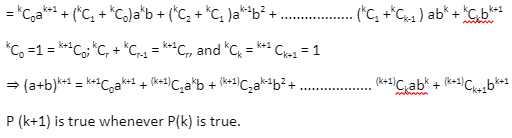
Therefore, P(n) is true for all positive integral values of n.
The binomial coefficients are the figures associated with the variables x, y, in the expansion of (x +y)n. The binomial portions are represented as nC0, nC1, nC2. The binomial coefficients are attained through the Pascal triangle or by using the combinations formula.
The binomial expansion has more application than algebra II. In statistics, it is used to calculate the binomial distribution.
This allows statisticians to quantify the risk of a certain number of positive results in a set of trials.
Binomial expansion is also intriguing from a fine perspective as it allows mathematicians to gain insight into the properties of polynomials.
Binomial developments are used in numerous numerical and logical calculations, including kinematic and gravitational time enlargement, active energy, electric quadrupole post and determining the relativity factor gamma, to mention a few.
The number of terms in a binomial expansion of a binomial articulation raised to some power is another factor of the binomial development.



 Profile
 Settings
 Refer your friends
 Sign out