The difference between any two consecutive terms in an arithmetic progression or arithmetic sequence is always the same. The common difference, denoted by d, is the difference between the consecutive terms. An arithmetic progression is a set of numbers in which each term is derived from the one before it by adding or subtracting a fixed number called the common difference “d” from the previous term.
The sequence 9, 6, 3, 0,-3… For example, is an arithmetic progression with -3 as the common difference. The Arithmetic Progression (AP) -3, 0, 3, 6, 9 is an AP with 3 as the common difference.
Sequence
A list of numbers in a specific order is known as a sequence or progression. It’s a series of numbers that follow a specific pattern, and the elements of a sequence are referred to as terms. There are many different types of universally accepted sequences, but the one we’ll look at right now is the arithmetic progression.
Arithmetic Progression
An arithmetic progression, also known as an arithmetic sequence, is a set of numbers in which the difference between successive terms remains constant.
General Form of AP
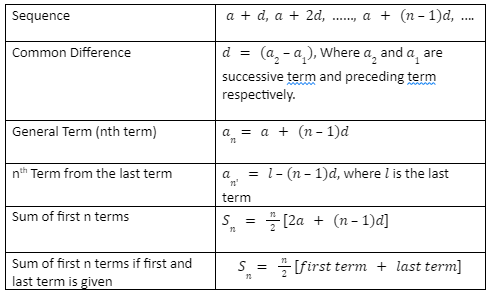
An Arithmetic Progression can take the following forms: a, a + d, a + 2d, a + 3d, and so on.
Tn = a + (n – 1) d is the nth term of an AP series, where Tn is the nth term and an is the first term. Tn – Tn-1 = d = common difference
Sum of n terms in Arithmetic Progression
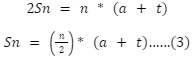
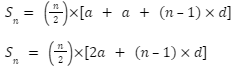
The formula below can be used to calculate the sum of the first n terms in arithmetic progressions.