Boric Acid, which is also known as hydrogen borate, orthoboric acid and, boracic acid, is a weak acid. In fact, it is an acidic hydrate of boric oxide with mild, antifungal, antiseptic and antiviral properties. The precise mechanism of action of boric acid is unidentified; usually cytotoxic to all cells. It is generally used in the treatment of yeast infections and fever blisters (also known as cold sores). It is one of the utmost produced borates and is extensively used all around the world in the pharmaceutical and cosmetic companies, as a nutritious supplement, flame retardant (which help reduce fire damage on people), in the manufacturing of glass as well as fiberglass, and in the manufacture of timber preservatives to control pests.
In our day-to-day life, we oftenly termed the boric acid as boric acid powder as it appears as a white powder. It is generally used as a pesticide i.e., for control of cockroaches. Actually it clings the cockroaches when they come in contact with this powder. This powder is also used as a fertiliser in crop fields, and also in detergents and hand soaps.
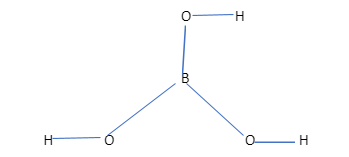
The chemical structure of boric acid is generally known as H3BO3, sometimes which is also written as B(OH)3. From this formula we can easily see that, the compound contains one boron atom, three hydrogen and three oxygen atoms in which three -OH groups i.e., hydroxyl groups are attached to one boron atom. The structure of the compound is as depicted below:
It has basically a two-dimensional structure, which lies on a plane. According to VSEPR theory, the molecular geometry of this compound is found to be trigonal planar.
Some of the basic physical properties of Boric Acid are as follows:
Boric acid might be prepared by reacting borax (sodium tetraborate decahydrate) with a mineral acid, for example hydrochloric acid(HCl):
Na2B4O7·10H2O + 2HCl → 4 B(OH)3 + 2 NaCl + 5 H2O
It can also be formed as a by-product of hydrolysis of boron trihalides and diborane. The reaction is as:
B2H6 + 6H2O→ 2B(OH)3 + 6H2
BX3 + 3H2O → B(OH)3 + 3HX (X = Cl, Br, I)
Generally, now a days this compound is widely used in many industries and factories. Let us see about few of its uses:
These are few of the uses of boric acid, but apart of all these uses there are also many more industrial as well as household uses of boric acid.
Boric acid and its sodium borate salts are insecticides found in nature and in a variety of industries. One of the most frequent products is borax. Boric acid and its sodium counterparts have various ways of combining boron with other elements. Their toxicity is mostly determined by the quantity of boron they contain.
Boric acid and its sodium counterparts are effective against a wide range of pests. Insects, spiders, mites, algae, moulds, fungi, and weeds are among them. Since 1948, products containing boric acid have been registered for use in the United States.



 Profile
 Settings
 Refer your friends
 Sign out