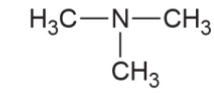
Amines are derived from ammonia. Alkyl or aryl groups replace one or more hydrogen atoms in ammonia. The –NH2 group is known as the amino group. Amides have a nitrogen atom attached to the carbon of the carbonyl group. The nitrogen atom has a pair of non-bonded electrons. Amides have similar chemical properties to that of amines. Amines are further divided into three categories; aliphatic amines, aromatic amines, and heterocyclic amines. When an alkyl group is attached to the nitrogen, it is Aliphatic amine. When an aryl group is attached to the nitrogen, it is aromatic amine. When nitrogen of an amine is a part of a cyclic ring, it is a heterocyclic amine. Amines are basic in nature.
Amines can be classified into three categories on the basis of the number of hydrogen atoms replaced in the ammonia molecule(NH3).
H2N–CH3
CH3–H2N–CH3
Amines are organic compounds derived from ammonia. Ammonia is an inorganic compound with a central nitrogen atom bonded to 3 hydrogen atoms. The valency of nitrogen being 5 in the structure of Ammonia or amines, it has a lone pair of electrons on it. When the hydrogen atoms of ammonia are replaced by either an aryl group, alkyl group, or a cyclic structure, it is termed as an amine. The structure of amine is classified into three categories on the basis of hydrogen atoms bonded to the central nitrogen atom. If two hydrogen atoms are bonded to the central nitrogen atom it is known as primary amine. If a single hydrogen atom is bonded to the central nitrogen atom it is known as secondary amine. If no hydrogen atom is bonded to the central nitrogen atom it is known as a tertiary amine. Amines play a crucial role in biology and have roles in air purification, water purification, and the production of dyes.



 Profile
 Settings
 Refer your friends
 Sign out