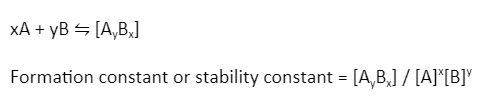
Every chemical compound wants to attain maximum stability, which holds for coordination compounds. It refers to the extent of association between the metal ion and the ligands when they are at equilibrium. The stability can be expressed by the formation constant, which is the ratio of the concentration of product and reactants raised to the power of their stoichiometric constant.
The complex is formed by Lewis acid-base interaction. The stronger the interaction, the more stable the complex would be.
The concept of complexes’ stability helps us determine their reactivity. Stability is inversely proportional to reactivity. The more stable a compound is, the less reactive it would be. As stated above, the stability of complexes can be determined by finding the formation constant, denoted by Kf.
Let’s understand that using an example:
If the value of Kf is high, that means the concentration of product in the solution would be high.
A metal ion does not exist in the solution freely. It exists in the solvated form, i.e., it is surrounded by solvent molecules. So, the ligand molecules compete with the solvent molecules for coordination with the metal centre.
Moreover, all the ligands do not coordinate with the metal at once. The coordination happens in a stepwise manner, wherein the first ligand coordinates first, followed by the second ligand, followed by the third ligand, and so on. The formation constant can be determined for each step :-
Here Kf1, Kf2, Kf3, and Kf4 are stepwise formation constants. To write the overall formation constant for the overall reaction M+4L `⇋ [ML4], we can multiply the stepwise formation constants.
So, Kf = Kf1 x Kf2 x Kf3 x Kf4
In most cases, the magnitude of the formation constant decreases as the number of ligands coordinated to the metal centre increases.
depends on the following factors:
As we move across the period, the ionic radius decreases (due to an increase in the number of protons in the nucleus, which increases the greater force on the valence shell). The stability, hence, increases across the period.
In this article, we discussed the stability of complexes, how to determine them, why it is important, and what factors it depends on. The stability of complexes depends on both the nature of the metal ion and that of the ligands. It is crucial as we can tune the stability of complexes by modifying either the metal or the ligand. Moreover, the formation of complexes is not a one-step process, but it happens through a series of reactions. Experimentally, stability is determined by Job’s method, which involves UV-visible studies of the compound. Let’s do a few stability questions now.



 Profile
 Settings
 Refer your friends
 Sign out