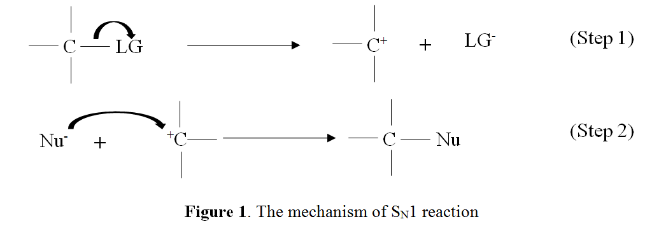
The SN1 reaction is a nucleophilic substitution process in which the rate-determining step occurs in a single molecular step. It is a form of organic substitution reaction in the classical sense. The abbreviation SN1 refers to substitution nucleophilic unimolecular. The rate equation (which indicates that the SN1 reaction is reliant on the electrophile but not on the nucleophile) holds true in instances where the amount of the nucleophile is significantly more than the amount of the carbocation intermediate in question.
The production of a carbocation intermediate is required for this reaction to occur. In most cases, it occurs in the reactions of tertiary or secondary alkyl halides with secondary or tertiary alcohols when the circumstances are extremely acidic or extremely basic, respectively. In inorganic chemistry, the SN1 reaction is referred to as the dissociative mechanism because of its dissociation nature. A few instances of nucleophilic substitution reactions of the SN1 type are shown in the following section.
SN1 Reaction is a chemical reaction that occurs in the body.
A solvent that facilitates the development of the carbocation intermediate will speed up the rate-determining step of the SN1 reaction, which is the rate-determining step of the reaction.
Solvents that are both polar and protic in nature are ideal for this type of reaction.
When it comes to stabilizing ionic intermediates, the polar nature of the solvent is beneficial, but the protic nature of the solvent is beneficial when it comes to solvating the departing group.
Water and alcohols are examples of solvents that have been utilised in SN1 reactions. These solvents also have the ability to act as nucleophiles.
The following steps can be used to understand the mechanism of the SN1 reaction, which is illustrated by the hydrolysis of tertiary butyl bromide as an example.
The sp² hybridized carbon intermediate created in step 1 of the SN1 reaction mechanism.. Its molecular geometry is trigonal planar, which allows for two alternative locations of nucleophilic attack on the molecule, one on the left and one on the right.SN1 reactions are significant because they define a mechanism of organic reactivity, or chemical reactivity, as far as we know. In terms of the rate-determining step, they describe a bond-breaking process, as opposed to SN2 reactions, which are bond-making processes.



 Profile
 Settings
 Refer your friends
 Sign out