In physics and chemistry, the wave nature of electrons is known as an atomic orbital. We can calculate the probability of finding an electron adjacent to the nucleus. The electron spin can be referred to as an indication of angular momentum as well as a quantum property of electrons. Electrons have an angular momentum described by their spin quantum number. In addition to their angular momentum, electrons possess orbital momentum as well.
Orbitals are three-dimensional representations of where electrons are likely to be located around atoms. When the atoms of a molecule form bonds, orbitals combine.
There are multiple orbitals for a quantum atom, which are differentiated by their size, shape, and orientation. In general, the smaller the orbital, the greater the chance of getting an electron close to the nucleus. Various orbitals have different shapes and are designated as s, p, d, and f.
The significance of s and p orbitals is due to their common occurrence in organic and biological chemistry. Atomic orbitals are the wave functions of electrons inside an atom. Furthermore, we can draw boundary surface diagrams with the help of this wave function. Even so, we can clearly describe the electron arrangement in an atom with quantum numbers.
Let us explore some of the most common types of orbitals and discuss the shape of orbitals.
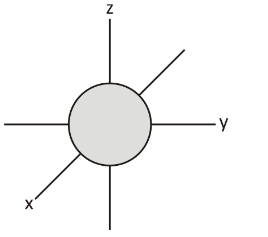
Around the nucleus of an atom, the s orbital shape has a spherically symmetrical form. Moving away from the nucleus, the energy level increases, which is why the orbitals grow. Near the nucleus, the electron density of a 1s orbital is quite low, but it gradually increases as you move away from the nucleus until it drops below the contour. 2s orbitals are similar to 1s orbitals, but they have an electron density sphere encased within the outer sphere. 3s orbitals have three nodes and are larger. Radial and angular nodes are two types of nodes. A nodal point is a place where it is unlikely for an electron to be found.
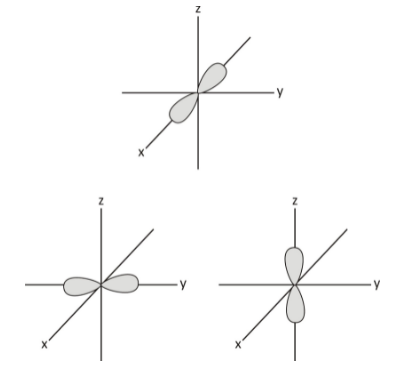
Dumbbell-shaped orbitals make up the p orbital shape. At the centre of the nucleus is the node in the p orbital. As opposed to s orbitals, p orbitals point in a specific direction. There are three orbitals in the p orbital to ensure it can accommodate six electrons at the most. When electrons are at the first energy level, their orbital is the 1s orbital, but as they attain the second energy level, they can also access the 2p and 2s orbitals. Every p orbital has a lobe on each side of the plane running through the nucleus.
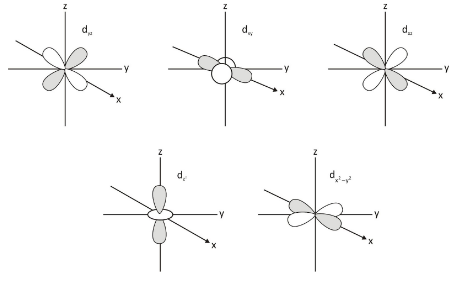
An orbital d can be visualised as a cloverleaf or as plane two dumbbells. dxy, dyz, dxz, dx2–Y2, and dz2 are the names of the five d-orbitals. Although all five orbitals have the same amount of energy, the first four orbitals are quite similar in shape, while the dz2 differs from the others.
In 1925, Samuel Goudsmit and G.E. Uhlenbeck proposed that the electron has an intrinsic angular momentum referred to as a spin. A classical theory describes the electron as a sphere, but the electron spin theory describes it as a quantum particle. The electron spins either upwards or downwards.
The three steps to identifying an electron spin are:
Quantum mechanics compute the properties of elementary units such as electrons using spin. Angular momentum, spin quantum number, and freedom degree are all affected by spin direction.
As a result of their motions and trajectories, electrons can be described by quantum numbers. An atom’s electron position and energy are described by quantum numbers. Quantum numbers can be divided into four types:
These are used to describe all the characteristics of each electron in an atom.
We now understand that with atomic orbitals, we can calculate the likelihood of finding electrons around a nucleus. There are four different kinds of orbitals (s, p, d, and f), each with a different size and different maximum capacity of holding two electrons. Furthermore, as the electron spins around its axis, it is considered to be electron spinning. There is a fourth quantum number, called the spin quantum number, which describes how an electron spin is oriented in space.



 Profile
 Settings
 Refer your friends
 Sign out