The Schiff test is a chemical method for determining whether or not an analyte contains aldehydes. This is accomplished by mixing a little amount of Schiff reagent with the analyte (which is the product formed in certain dye formulation reactions such as the reaction between sodium bisulfite and fuchsin). Schiff’s reagent, Schiff test, Schiff reagent formula, Schiff reagent test, Schiff reagent preparation, Rosaline structure, and Schiff’s test for aldehydes are all covered in this article.
The Schiff test is a rather generic chemical test for the identification of numerous organic aldehydes that have also found utility in the staining of biological tissues. It was invented by Hugo Schiff in early organic chemistry. The Schiff reagent is the reaction product of a dye formulation like fuchsin and sodium bisulfite; dye alternatives like pararosaniline (which lacks an aromatic methyl group) and new fuchsin (which is uniformly mono-methylated ortho to the dye’s amine functionalities) do not have comparable detection chemistry.
When the unknown material is given to the decolourized Schiff reagent as a qualitative test for aldehydes, a characteristic magenta colour develops when aldehyde is present. Various biological tissue staining procedures, such as Feulgen stain and periodic acid-Schiff stain, use Schiff-type chemicals. The termini of saccharides in human skin also contain aldehyde functional groups, hence it is discoloured.
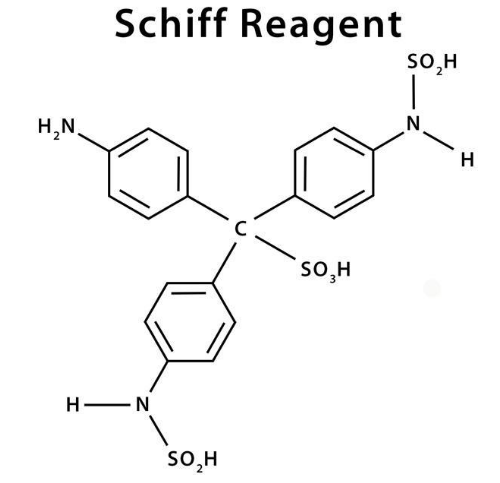
The chemical formula of the reagent is C19H21N3S2O7.4H2O
The reagent is composed of :
Water (H2O) >98%
The solution is shaken at regular intervals before being decoloured with charcoal. After that, the mixture is filtered. To ensure the production of a totally colourless solution, fresh activated charcoal must be utilized. If the solution is not colourless, it is filtered again.
The following are the specific steps in the preparation process:
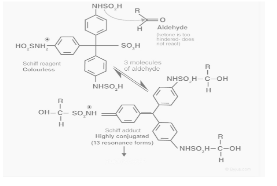
The bisulfite and para-rosaniline react to form a decolourized adduct with a sulfonated central carbon. Now, the aromatic ring’s free and uncharged amine groups combine with the aldehyde group to generate an aldimine. Because the aldimine group is a strong electrophile, it conducts a second reaction with the bisulfite ion. Finally, a bisulfite adduct of purple or magenta colour forms.
The result of several dye formulation processes, such as the reaction between sodium bisulfite and fuchsine, is Schiff reagent. It’s used to see if there’s any aldehyde in an analyte. It can help distinguish between aldehydes and ketones. Sodium bisulfate decolorizes fuschsine or rosaniline hydrochloride, a magenta-coloured dye having the molecular formula C19H21N3S2O7.4H2O .



 Profile
 Settings
 Refer your friends
 Sign out