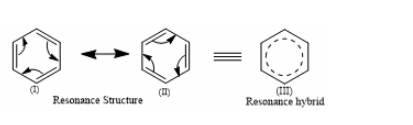
Resonance effect is the polarity formed in a molecule as a result of contact between a lone pair of electrons and a pi bond, or the interaction of two pi bonds between two nearby atoms. In molecules with conjugated double bonds or at least one lone pair of electrons and one double bond, the effect is observable. The bigger the number of resonance contributors, the stronger the resonance stabilisation effects, and the more stable the species is, according to the resonance effect. So, in order to anticipate whether the resonance effect is present or not, we usually have to build “new” resonance structures (contributors) based on the existing ones.
In the case of Benzene:
Three C-C single bonds with a bond length of 1.54 A and three C=C double bonds with a bond length of 1.34A are found in the aforementioned structures (I) and (II). However, it was discovered that all six carbon and carbon bonds are identical, and a 1.39 A intermediate C-C and C+C bond was discovered. The poor reactivity of halogen in vinyl bromide can be explained further by the phenomena of resonance.
Resonance energy is the difference between the real molecule and the more stable canonical form.
The high utility of resonance theory and its worth comes from the fact that it maintains the simple and unsophisticated form of structural representation.
The carbocation that conjugates a positive charge with a double bond tends to be more stable. The allylic carbocation is more stable than the comparable alkyl cation because of the resonance structure. The resonance structures are formed when the negative electrons of the conjugated double bonds are delocalised, which increases their stability. The stability will be great if the resonating structure is great.
The availability of double bonds or an aromatic ring will enhance the anion’s stability around the negatively charged atom because of resonance.
A point to be noted: the bigger the resonance structure, the more stable it will be.
Due to resonance, the negative charge on benzyl carbanion disperses over additional carbon atoms, making it more stable than ethyl carbanion.
Due to depolarisation of the unpaired electrons across the system, simple alkyl radicals are less stable allylic and benzylic forms of free radicals.
In chemistry, resonance is an intramolecular electrical phenomenon in which the location of a pi bond(s) or a nonbonding electron changes (also called a sigma bond). In this procedure, however, the location of an atom is changed by modifying the pi electrons’ position or the non-bonding electrons’ position.
Resonance is a property of organic compounds. In organic chemistry, the delocalised electrons inside a specific compound when a single Lewis structure does not express the bond are referred to as resonance. To portray delocalised electrons in an ion or molecule, several structures known as resonance can be used.



 Profile
 Settings
 Refer your friends
 Sign out