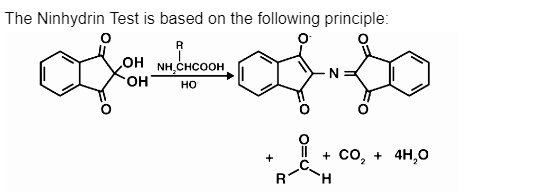
When ninhydrin (a chemical molecule having the formula C9H6O4 and the IUPAC name 2,2-dihydroxybenzene-1,3-dione) is added to a test solution of the analyte, the result is known as the ninhydrin concentration. It is believed that the development of a deep blue colour in the analyte is due to the presence of ammonia, primary or secondary amines, or amino acids.
The amino group of the analyte results in the formation of a molecule that is comparable to diketohydrin. The colour of this combination is a deep blue that is sometimes referred to as Ruhemann’s purple.
The amino group of a free amino acid is subjected to a chemical reaction with ninhydrin, which has the property of acting as an oxidising agent. When exposed to ninhydrin, the amino acid undergoes oxidative deamination, resulting in the release of CO2, NH3, and an aldehyde, as well as the formation of hydrindantin and other byproducts of the reaction (which is a reduced form of ninhydrin).
As a result of this reaction, the ammonia reacts with yet another ninhydrin molecule, resulting in the formation of diketohydrin (also known as Ruhemann’s complex). The vivid blue colour is due to the presence of this compound.. Because proline is an amino acid, a yellow coloured compound is generated when the analyte contains Amino-acids, such as proline. When asparagine is employed, the resultant complex has a brown colour to it.
Therefore it can be concluded, presence of amino acids, the development of a deep blue/violet colour shows their presence.
Interpretation of the Ninhydrin Test Results
Ammonia, primary/secondary amines, and amino acids all produce a deep purple colour when exposed to light.
A yellow colour is created from the amino acids hydroxyproline and proline.
When asparagine is used, a brown colour is produced.
It is assumed that the analyte does not include amino acids, amines, or ammonia if no colour change is detected.



 Profile
 Settings
 Refer your friends
 Sign out