In a chemical reaction, the state where both reactants and products are present in constant concentrations, with no tendency to change in time, is called a chemical equilibrium state. This state occurs when the forward and reverse reactions happen at the same rate. The reaction rates of both the backward and forward reactions are equal and opposite. Consequently, there are no net changes in the concentrations of the reactants and products.
For example, a bottle of fizzy drink has CO2 dissolved in liquid and the surroundings. However, no transfer of CO2 occurs until and unless the environment is hampered.
There are two types of equilibrium that are physical and chemical where chemical equilibrium is dynamic and physical equilibrium is static.
When The forces of action and reaction cancel each other, and no change occurs, it is called a static equilibrium state—for example, a book lying on the table.
Both action and reaction are continuously happening in equal amounts and opposite directions. It is called a dynamic equilibrium state. For example, a man going upwards in an escalator that’s going downwards.
A process where two or more substances mix together and form new substances. They are of two types
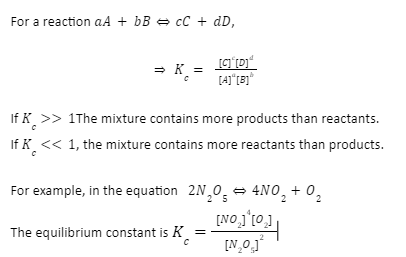
The law of chemical equilibrium shows a relationship between the concentrations of reactants and products. It states that the equilibrium constant is the ratio of the product of product side concentrations to the product of reactants side concentration. Accordingly, each term should be raised to the power of their stoichiometric coefficient in a balanced chemical equation.
At a given temperature, the value of the equilibrium constant expresses the relationship between the concentration of products and reactants present at chemical equilibrium in a reversible chemical reaction. It is denoted by the letter K, and its formula is,
At a given temperature, it has a definite value for every reaction independent of the original concentration of reactants. It predicts the extent and direction of a given reaction.
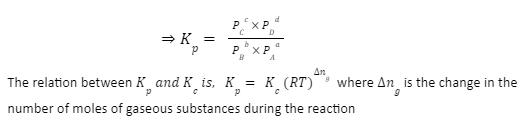
When partial pressures are used instead of molar concentrations, the constant is called the pressure equilibrium constant. Kp represents it, and its formula is
The law of chemical equilibrium or the law of mass action finds it used in many places. Some of the most important ones are,
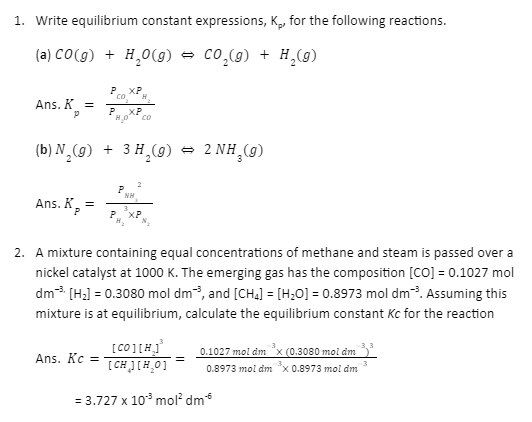
In this section, we learned about equilibrium and its types, Chemical equilibrium, and its law. We also learned about the various applications of chemical equilibrium. Finally, we did some sample problems on chemical equilibrium.



 Profile
 Settings
 Refer your friends
 Sign out