Access free live classes and tests on the app
Download
+
Unacademy's Blog!
Login Join for Free
avtar
  • ProfileProfile
  • Settings Settings
  • Refer your friendsRefer your friends
  • Sign outSign out
  • Terms & conditions
  • •
  • Privacy policy
  • About
  • •
  • Careers
  • •
  • Blog

© 2023 Sorting Hat Technologies Pvt Ltd

Challenge Yourself Everyday Attempt 2023’s and previous year’s JEE Main Download Important Formulas pdf Attempt Free Test Series for JEE Main 2023

Trending Topics

  • JEE Main 2024
  • JEE Main Rank Predictor 2024
  • JEE Main Mock Test 2024
  • JEE Main 2024 Admit Card
  • JEE Advanced Syllabus
  • JEE Preparation Books
  • JEE Notes
  • JEE Advanced Toppers
  • JEE Advanced 2022 Question Paper
  • JEE Advanced 2022 Answer Key
  • JEE Main Question Paper
  • JEE Main Answer key 2022
  • JEE Main Paper Analysis 2022
  • JEE Main Result
  • JEE Exam Pattern
  • JEE Main Eligibility
  • JEE College predictor
[wp_login_wall media_id="424566" text_before_login="Download JEE Main PYQs" text_after_login="Download JEE Main 2022 Question Papers"]

JEE Coaching Centres

  • JEE Coaching in Nagpur
  • JEE Coaching in Ranchi
  • JEE Coaching in Gorakhpur
  • JEE Coaching in Bhubaneswar
  • JEE Coaching in Vijayawada
  • JEE Coaching in Dehradun
  • JEE Coaching in Indore
  • JEE Coaching in Gurugram
  • JEE Coaching in Muzaffarpur
  • JEE Coaching in Varanasi
  • JEE Coaching in Jammu
  • JEE Coaching in Kolhapur
  • JEE Coaching in Bikaner
  • JEE Coaching in Delhi Lajpat Nagar
Predict your JEE Rank . [wp_custom_style style=".side-btn-second{margin: 1px 0px;}"][wp_custom_script script="document.querySelector('.targetTopBtn').onClick = topFunction; function topFunction() { window.scrollTo({ top: 0, behavior: 'smooth' }) }"][wp_custom_style style=".side-btn-second{margin: 1px 0px;} .elementor-element.elementor-element-dcb2b31{display: none !important;}"]
Challenge Yourself Everyday Attempt 2023’s and previous year’s JEE Main Download Important Formulas pdf Attempt Free Test Series for JEE Main 2023

Trending Topics

  • JEE Main 2024
  • JEE Main Rank Predictor 2024
  • JEE Main Mock Test 2024
  • JEE Main 2024 Admit Card
  • JEE Advanced Syllabus
  • JEE Preparation Books
  • JEE Notes
  • JEE Advanced Toppers
  • JEE Advanced 2022 Question Paper
  • JEE Advanced 2022 Answer Key
  • JEE Main Question Paper
  • JEE Main Answer key 2022
  • JEE Main Paper Analysis 2022
  • JEE Main Result
  • JEE Exam Pattern
  • JEE Main Eligibility
  • JEE College predictor
[wp_login_wall media_id="424566" text_before_login="Download JEE Main PYQs" text_after_login="Download JEE Main 2022 Question Papers"]

JEE Coaching Centres

  • JEE Coaching in Nagpur
  • JEE Coaching in Ranchi
  • JEE Coaching in Gorakhpur
  • JEE Coaching in Bhubaneswar
  • JEE Coaching in Vijayawada
  • JEE Coaching in Dehradun
  • JEE Coaching in Indore
  • JEE Coaching in Gurugram
  • JEE Coaching in Muzaffarpur
  • JEE Coaching in Varanasi
  • JEE Coaching in Jammu
  • JEE Coaching in Kolhapur
  • JEE Coaching in Bikaner
  • JEE Coaching in Delhi Lajpat Nagar
Predict your JEE Rank . [wp_custom_style style=".side-btn-second{margin: 1px 0px;}"][wp_custom_script script="document.querySelector('.targetTopBtn').onClick = topFunction; function topFunction() { window.scrollTo({ top: 0, behavior: 'smooth' }) }"][wp_custom_style style=".side-btn-second{margin: 1px 0px;} .elementor-element.elementor-element-dcb2b31{display: none !important;}"]
JEE Main 2026 Preparation: Question Papers, Solutions, Mock Tests & Strategy Unacademy » JEE Study Material » Chemistry » Introduction to Work
Challenge Yourself Everyday Attempt 2023’s and previous year’s JEE Main Download Important Formulas pdf Attempt Free Test Series for JEE Main 2023

Trending Topics

  • JEE Main 2024
  • JEE Main Rank Predictor 2024
  • JEE Main Mock Test 2024
  • JEE Main 2024 Admit Card
  • JEE Advanced Syllabus
  • JEE Preparation Books
  • JEE Notes
  • JEE Advanced Toppers
  • JEE Advanced 2022 Question Paper
  • JEE Advanced 2022 Answer Key
  • JEE Main Question Paper
  • JEE Main Answer key 2022
  • JEE Main Paper Analysis 2022
  • JEE Main Result
  • JEE Exam Pattern
  • JEE Main Eligibility
  • JEE College predictor
[wp_login_wall media_id="424566" text_before_login="Download JEE Main PYQs" text_after_login="Download JEE Main 2022 Question Papers"]

JEE Coaching Centres

  • JEE Coaching in Nagpur
  • JEE Coaching in Ranchi
  • JEE Coaching in Gorakhpur
  • JEE Coaching in Bhubaneswar
  • JEE Coaching in Vijayawada
  • JEE Coaching in Dehradun
  • JEE Coaching in Indore
  • JEE Coaching in Gurugram
  • JEE Coaching in Muzaffarpur
  • JEE Coaching in Varanasi
  • JEE Coaching in Jammu
  • JEE Coaching in Kolhapur
  • JEE Coaching in Bikaner
  • JEE Coaching in Delhi Lajpat Nagar
Predict your JEE Rank . [wp_custom_style style=".side-btn-second{margin: 1px 0px;}"][wp_custom_script script="document.querySelector('.targetTopBtn').onClick = topFunction; function topFunction() { window.scrollTo({ top: 0, behavior: 'smooth' }) }"][wp_custom_style style=".side-btn-second{margin: 1px 0px;} .elementor-element.elementor-element-dcb2b31{display: none !important;}"]

Introduction to Work

In this article we will learn about work, mathematical expression for work, unit of work, work done for different values of theta, scientific concept of work, concept of heat and work and work done in thermodynamic processes.

Table of Content
  •  

Work is a physics term describing the amount of energy transferred when an object is moved over a distance by an external force, at least a portion of which is applied in the direction of displacement.

Work can be calculated by multiplying the length of the path by the component of the force acting along the path if the force is constant.

Mathematical expression for Work

Work is done on an object when a force works in or against the direction of motion of the object.

W=F△x cosθ

Here,

W = Work done in Joules (J)

F = Magnitude of force in newton (N)

Δx = Value of displacement in metre (m)

θ = angle between force and the direction of movement of the body.

Unit of Work

The S.I. Unit of work is considered as Joule(J).

For example, if a force of 10N is applied on a body and it is displaced by 15m at an angle of , then the work done will be 

W = FΔx cos θ

W = 10 ✕ 15 ✕ cos θ

W = 75 J

Work done for different values of angle theta ( θ)

Now that we know about the mathematical expression of work, we should always keep in mind and consider the following factors while calculating work done.

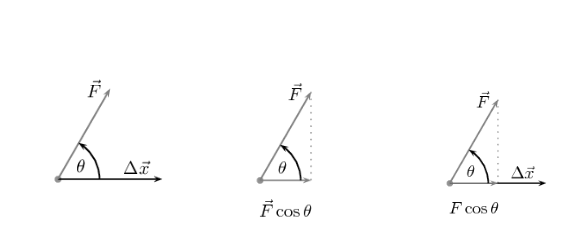
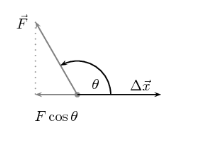
The magnitude of the component of and is F cos θ . If the value of θ > 90° , the component will be parallel to the displacement direction but it points in the other direction, and the force opposes the motion.

cos θ indicates the force’s relative direction as well as the displacement. The sign of the displacement vector and force vector will be different if the component of the force along the direction of the displacement is opposite in direction to the displacement. This is true regardless of which positive direction was picked.

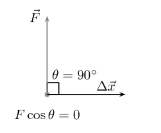
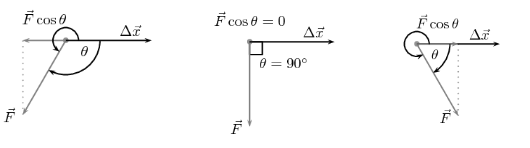
Let’s look at some examples to better grasp these situations. The grey dot in the figures below symbolises an object. The object is acted upon by a force, . denotes the displacement of the object. In each situation, let us determine the sign of work done.

  • At θ = 90°  ,  cos θ = cos 90° = 0 
  • F cos θ = F cos 90° = 0

             Therefore, work done is also ZERO.

  • At θ  > 90°, the magnitude of the component of the force is along the displacement line in the opposite direction of the displacement. 

Cos θ < θ

F Cos θ < θ

           Therefore, the work done is NEGATIVE,

  • It is necessary to keep in mind that for work to be done, a component of the applied force must be directed in the direction of motion. There is no work done by forces that are perpendicular to the direction of motion.

Scientific concept of work

When we apply force ‘F’ to a block, the body travels with an acceleration or its speed rises or declines depending on the direction of the force. The kinetic energy of the system changes as the speed increases or decreases. We know that energy cannot be created or destroyed, thus it must be changed into another form.  It is referred to as work done in this situation. When negative work is done, the energy declines, and when positive work is accomplished, the energy increases. 

Concept of heat and work

Heat: Consider a system that has both hot and cold parts within it. Conduction, radiation, and/or convection will transport energy from the hot to the cold region due to the temperature differential. Heat is exclusively given to energy transfer, not mass transfer, that occurs at the system’s surface. When the condition of the system changes, heat enters or exits the system. Heat isn’t a property, hence it doesn’t have a single value. The amount of heat that is transported is determined by the procedure (how the system moves from state 1 to state 2).

Heat is energy that is transported through the system’s surface via conduction and radiation methods.

Convection is not included since it involves a mass flow, and the energy associated with that mass will be examined separately. Heat is thus arbitrarily defined as a surface effect:

Heat is energy transported over a system’s boundary without the transfer of mass due to a temperature difference between the system and its surroundings.

Work: Work, like heat, is a transitory phenomenon that cannot be stored in mass or a system. Work is a surface concept that exists or occurs only during the passage of energy into or out of a system. After the work is completed, all that remains is the effort’s result: energy. Work into or out of the system happens as the system changes state, just like heat. Work is not a commodity, hence it cannot be single-valued. The procedure (how the system progresses from state 1 to state 2) determines the quantity of work transferred.

By paraphrasing the definition for heat, a general definition for all types of work may be formed:

Work is energy transported over a system’s boundary without the transmission of mass due to a significant physical difference between the system and its surroundings other than temperature.


Work Done for Thermodynamic Process

Isochoric, isobaric, isothermal, and adiabatic are the four basic thermodynamic processes. The following are the equations for work done in different thermodynamic processes:

1.Isochoric process: The isochoric process is defined as one in which the volume remains constant. 

Δ V = 0

Since the volume change in an isochoric process is zero, the work done is also zero.

W = PΔV = 0

2.Isobaric process: The isobaric process is one in which the system’s pressure does not change (remains constant).

Δ P = 0

The formula for work done in an isobaric process is given as:

W = PΔV

3.Isothermal process: The isothermal process is one in which the system’s temperature remains constant.

Δ T = 0

The formula for work done in isothermal process is given as:

W=nRTln[V1/V2]

n = no. of moles of gas

R = universal gas constant = 8.3144 J.K-1.mol-1 

V1 & V2 = initial and final volumes of the system

4.Adiabatic process: The adiabatic process is one in which the system’s heat energy does not change.

Δ Q = 0

The formula for work done in adiabatic process is given as:

W=1/1-ϒ[P2V2-P1V1]

ϒ=adiabatic index

 P1 & P 2 = initial and final pressures of the system

V1 & V2 = initial and final volumes of the system

Conclusion

Work is the force that causes an object to move or be displaced. In the case of a constant force, it is the scalar product of the force applied on an object and the displacement induced by that force. Despite the fact that both force and displacement are vector values, it has no direction due to the nature of a scalar product.

Heat is energy transported over a system’s boundary without the transfer of mass due to a temperature difference between the system and its surroundings. On the other hand, Work is energy transported over a system’s boundary without the transmission of mass due to a significant physical difference between the system and its surroundings other than temperature.

faq

Frequently asked questions

Get answers to the most common queries related to the IIT JEE Examination Preparation.

The specific temperatures of Cp and Cv in gases are two times greater than those in solids and liquids, which is why.

Ans: The specific temperatures of gases are denoted by the letters Cp and Cv under constant pressure and constant volume, respectively, whereas the...Read full

Can you explain the relationship between CP and CV?

ANS.CP stands for specific heat capacity of a material under constant pressure. CV is a measure of a substance’s specific heat capacit...Read full

What is the CP/CV Ratio in this case?

Ans:The CP/CV ratio, often known as the adiabatic index, is the ratio of specific temperatures to specific volume.

What is the reason that Cp is bigger than Cv?

Ans.Due to the fact that when gas is heated at constant volume, the entire amount of heat supplied is required to raise the temperature alone, cp i...Read full

What is the difference between Cp and Cv?

Ans.Cp is the phrase used to describe the molar heat capacity of a substance when the pressure is constant, whereas Cv is the term...Read full

Ans: The specific temperatures of gases are denoted by the letters Cp and Cv under constant pressure and constant volume, respectively, whereas the specific heats of solids and liquids are denoted by a single letter.

ANS.CP stands for specific heat capacity of a material under constant pressure.

CV is a measure of a substance’s specific heat capacity at a constant volume.

Arrangements:

CP-CV=R, where R denotes the gas constant.

Cp/Cv = Y(also known as the ‘gamma’ specific heat capacity ratio).

Ans:The CP/CV ratio, often known as the adiabatic index, is the ratio of specific temperatures to specific volume.

Ans.Due to the fact that when gas is heated at constant volume, the entire amount of heat supplied is required to raise the temperature alone, cp is greater than CV. When gas is heated at constant pressure, on the other hand, the heat that is given is used to increase both the temperature and the volume of the gas being heated.


Ans.Cp is the phrase used to describe the molar heat capacity of a substance when the pressure is constant, whereas Cv is the term used to indicate the molar heat capacity of a substance when the volume is constant. As a result, the molar heat capacity is defined by these two factors when pressure and temperature are varied.

Challenge Yourself Everyday
Attempt 2023’s and previous year’s JEE Main
Download Important Formulas pdf
Attempt Free Test Series for JEE Main 2023

Trending Topics

  • JEE Main 2024
  • JEE Main Rank Predictor 2024
  • JEE Main Mock Test 2024
  • JEE Main 2024 Admit Card
  • JEE Advanced Syllabus
  • JEE Preparation Books
  • JEE Notes
  • JEE Advanced Toppers
  • JEE Advanced 2022 Question Paper
  • JEE Advanced 2022 Answer Key
  • JEE Main Question Paper
  • JEE Main Answer key 2022
  • JEE Main Paper Analysis 2022
  • JEE Main Result
  • JEE Exam Pattern
  • JEE Main Eligibility
  • JEE College predictor

JEE Coaching Centres

  • JEE Coaching in Nagpur
  • JEE Coaching in Ranchi
  • JEE Coaching in Gorakhpur
  • JEE Coaching in Bhubaneswar
  • JEE Coaching in Vijayawada
  • JEE Coaching in Dehradun
  • JEE Coaching in Indore
  • JEE Coaching in Gurugram
  • JEE Coaching in Muzaffarpur
  • JEE Coaching in Varanasi
  • JEE Coaching in Jammu
  • JEE Coaching in Kolhapur
  • JEE Coaching in Bikaner
  • JEE Coaching in Delhi Lajpat Nagar
Predict your JEE Rank
.
Challenge Yourself Everyday
Attempt 2023’s and previous year’s JEE Main
Download Important Formulas pdf
Attempt Free Test Series for JEE Main 2023

Trending Topics

  • JEE Main 2024
  • JEE Main Rank Predictor 2024
  • JEE Main Mock Test 2024
  • JEE Main 2024 Admit Card
  • JEE Advanced Syllabus
  • JEE Preparation Books
  • JEE Notes
  • JEE Advanced Toppers
  • JEE Advanced 2022 Question Paper
  • JEE Advanced 2022 Answer Key
  • JEE Main Question Paper
  • JEE Main Answer key 2022
  • JEE Main Paper Analysis 2022
  • JEE Main Result
  • JEE Exam Pattern
  • JEE Main Eligibility
  • JEE College predictor

JEE Coaching Centres

  • JEE Coaching in Nagpur
  • JEE Coaching in Ranchi
  • JEE Coaching in Gorakhpur
  • JEE Coaching in Bhubaneswar
  • JEE Coaching in Vijayawada
  • JEE Coaching in Dehradun
  • JEE Coaching in Indore
  • JEE Coaching in Gurugram
  • JEE Coaching in Muzaffarpur
  • JEE Coaching in Varanasi
  • JEE Coaching in Jammu
  • JEE Coaching in Kolhapur
  • JEE Coaching in Bikaner
  • JEE Coaching in Delhi Lajpat Nagar
Predict your JEE Rank
.
Company Logo

Unacademy is India’s largest online learning platform. Download our apps to start learning


Starting your preparation?

Call us and we will answer all your questions about learning on Unacademy

Call +91 8585858585

Company
About usShikshodayaCareers
we're hiring
BlogsPrivacy PolicyTerms and Conditions
Help & support
User GuidelinesSite MapRefund PolicyTakedown PolicyGrievance Redressal
Products
Learner appLearner appEducator appEducator appParent appParent app
Popular goals
IIT JEEUPSCSSCCSIR UGC NETNEET UG
Trending exams
GATECATCANTA UGC NETBank Exams
Study material
UPSC Study MaterialNEET UG Study MaterialCA Foundation Study MaterialJEE Study MaterialSSC Study Material

© 2026 Sorting Hat Technologies Pvt Ltd

Unacademy's Blog!

Share via

COPY