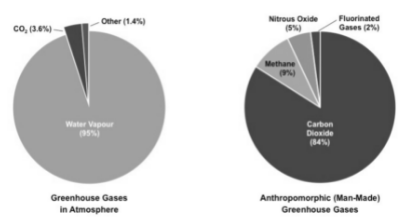
Greenhouse gases are naturally present in the Earth’s atmosphere in less than 1%. Their role is significant in supporting life on Earth as they maintain the hospital temperature for survival. Without greenhouse gases, the Earth’s average temperature would fall from 14 degrees Celsius to a freezing minus 18 degrees Celsius! However, today anthropogenic greenhouse gas emissions lead to rising Earth’s temperature and warming it to an above-normal level. It occurs due to the increased amount of greenhouse gases in the Earth’s atmosphere (Troposphere) that prevents the solar radiation from falling onto it to escape via infrared radiation.
This phenomenon is Global Warming which is already wreaking havoc on the natural greenhouse effect balance. In this study material notes on the Greenhouse effect, we shall discuss everything about the greenhouse effect.
Almost 75% of the Solar radiation that falls on the Earth’s surface gets absorbed by greenhouse gases and water vapours and warms it up. It is responsible for maintaining the Earth’s average temperature hospitable at 15 degrees Celsius for living organisms. However, if the greenhouse gases amount cross more than a suitable degree, it causes unnatural heating of the Earth, known as Global Warming.
The natural greenhouse effect is the trapping of heat by the atmospheric gases analogous to a glass-covered greenhouse used to grow vegetables in cold climates. The blanket of air functions as glass and traps the sun’s heat to maintain the Earth’s constant temperature.
No, such gases are usually removed from the atmosphere periodically. Carbon dioxide also gets absorbed in the ocean to maintain the equilibrium of the atmospheric and oceanic concentrations. It also is absorbed by other carbon sinks like plants, soil, etc.
Though, the synthetic greenhouse gases that arise anthropogenically can get destroyed only by sunlight above the troposphere and include gases like Ozone.
The solar radiations fall on the Earth’s surface and get reemitted as infrared radiations. These infrared radiations are a type of short-wave radiation that gets absorbed by the greenhouse gases present in the atmosphere.
Carbon dioxide is the major contributor to the greenhouse effect and thus global warming. The prime sources of greenhouse gases emissions include Transportation, Manufacturing & Industrial sectors, Electricity generation, Forest fires, etc.
We can reduce global warming by focussing on sustainable development with the switch to renewable resources, etc.



 Profile
 Settings
 Refer your friends
 Sign out