Glucose is a monosaccharide that our body receives through food and utilizes as an important source of energy. The fundamental molecular indication of glucose is C6H12O6.
The process by which carbon dioxide is converted into glucose in plants is known as the Calvin cycle. In this process, the formation of one glucose molecule requires 18 ATP and 12 NADPH. In plants, glucose is mainly found in fruits and in the different other parts. The best example of the use of glucose is a symbiotic relationship between plants and fungi, in which fungi provide water and minerals to the plants, and in turn, plants give glucose to the fungi as a source of energy.
Glucose enters our body as galactose and fructose in various forms, which are mainly isomers and monosaccharides of glucose. Our body breaks down complex sugars into galactose, glucose and fructose for soaking up and metabolism.
In addition to obtaining glucose from food, our body prepares glucose by a procedure called gluconeogenesis. Gluconeogenesis is the formation of glucose with the help of non-carbohydrate compounds. It is a ubiquitous process present in plants, animals, fungi, bacteria and other microorganisms.
Glucose is stored in the form of glycogen in our muscles and liver. Whenever there is a deficiency of glucose in our body, this stored form of glycogen gets converted into glucose and then released into the blood. The whole process is carried out with the help of the hormone glucagon, which is responsible for the increase in blood glucose levels. This hormone is synthesized by the alpha cells of islets of Langerhans (it is the endocrine part of the pancreas). With the help of glucose and oxygen, our body makes the energy currency of the cell known as ATP (Adenosine Triphosphate).
The diseases associated with glucose often occur when blood glucose levels are either too high or too low. Blood glucose level is maintained by two hormones:
Hyperglycemia: This is a condition where blood sugar level gets higher than normal. The symptoms of hyperglycemia are:
When the blood glucose level gets higher than normal, it leads to diabetes mellitus. In this condition, glucose gets released out of the body through the urine; such a condition is called glycosuria. Ninety-Nine per cent of glucose from the filtrate is reabsorbed by the proximal convoluted tubule of the kidney.
Hypoglycemia: This is the condition where blood glucose level gets lower than normal. The symptoms of hypoglycemia are:
Normal blood glucose level of the body ranges from 70 to 90 mg/dL. Higher ranges than this lead to prediabetes or diabetes. The test used for the determination of blood glucose level is the A1c test. This test is useful for getting the exact information of the blood glucose in your body. This A1c test is mainly used in the diagnosis of diabetes and prediabetes. It is considered a preliminary test in the management of diabetes.
Sugars are mainly polyhydroxylated (containing a large number of OH groups) chains of carbon atoms that, in addition, feature an aldehyde or ketone group. In general, all sugars have the 1:2:1 ratio as Carbon: Hydrogen: Oxygen. Glucose possesses the property of undergoing inter or intramolecular reactions between the groups like hydroxyl and carbonyl.
Reaction:
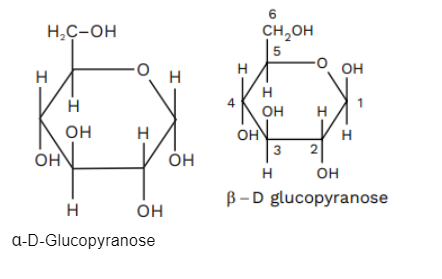
It is an intramolecular reaction when an aldose directly cyclizes the hydroxyl group present on the C5. Due to such conditions, C5 shows an intramolecular reaction with the C1 carbonyl group of the aldehyde. The product is hemiacetal.
It is the two-dimensional representation of sugar D-glucose on the left-hand side called Fischer Projection.
The resultant 3-dimensional representation of D-glucose cyclization product hemiacetal is called Haworth Projection.
This is the most commonly occurring simple sugar. It acts as an important base or building block for the formation of disaccharides, sucrose, lactose, higher oligosaccharides and polysaccharides. It is a sugar unit in cellulose and starch. D-glucose is also present in open form, but 99% of it is present in the form of a solution.
Glucose is a simple sugar, which acts as a building block for disaccharides, oligosaccharides, and many polysaccharides. Glucose is also called hexose sugar, as it consists of six carbons. Extensive information about glucose is available as numerous researches are conducted on glucose, the most popular being D-Glucose structure. Researchers have been awarded for their work on educating about the different structures of glucose like D-glucose and other sugars.



 Profile
 Settings
 Refer your friends
 Sign out