Catalysis is a phenomenon in which the rate of a reaction is sped up or slowed down by the use of a catalyst (the catalyst does not participate in the reaction; its concentration and composition remain unchanged). A catalyst is a substance that is used to influence the rate of a reaction. Enzymes are a type of catalyst that helps to speed up and facilitate a variety of important metabolic events in plants and animals. Enzyme catalysis is a type of catalysis in which enzymes function as a catalyst. Enzymes are nitrogen-containing complex molecules. These substances are produced spontaneously in the bodies of animals and plants. When dissolved in water, enzymes have a high molecular mass and form a heterogeneous mixture. These proteins have a high efficiency and are responsible for a variety of processes in living beings’ bodies.
Enzymes have a lot of cavities on their exterior surface. These cavities have groups like -COOH, -SH, and so on. The active centre of a biological particle is defined as these centres. The substrate, which is charged in the opposite direction as the enzyme, fits into the cavities like a key into a lock. The complex produced decomposes to give the products due to the presence of active groups.
As a result, there are two steps:
Step 1: The enzyme and the reactant are combined.
E + R ER
Step 2: The complicated molecule is disintegrated to produce the final product.
E R E + R
Enzymes have biological as well as chemical properties. Their sequences and architectures define their function in all living creatures’ genomes and proteomes, and their ability to catalyse chemical reactions expands their biological function to metabolic pathways and networks. Many enzymes are promiscuous, performing many reactions, and their reaction profiles can alter as the protein sequence changes. To capture the core of enzyme chemistry in a functional categorization, bond modifications and reaction centres must be combined with structural information about substrates, products, and processes. The development of tools to navigate across reaction space (e.g., EC-BLAST) has paved the way for a more accurate description of enzyme reactions, allowing for a more comprehensive understanding of biological function.
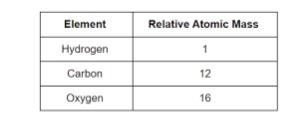
The relative atomic mass of an element is the relationship between its mass and the number of atoms it contains. The relative atomic mass scale is used to calculate the masses of different atoms.
The hydrogen atom, the lightest atom, was given a relative atomic mass of 1, and the relative atomic masses of other atoms were calculated in comparison.
The gram atomic masses of elements are their atomic masses given in gram. The atomic mass of an oxygen molecule, for example, is 16 amu.
As a result, oxygen has a gram atomic mass of 16 g.
The number of times a material’s particle is heavier than one-twelfth the mass of a carbon atom – 12 – is the sub-atomic mass of the substance. Alternatively, the sub-atomic mass is equal to the sum of the atomic masses of the seeming plurality of particles present in a single material particle. Take, for example, water.
H has an atomic mass of one unit.
O has an atomic mass of 16 units.
Water has a subatomic mass of 2 atomic masses of H + 1 atomic mass of O.
= 2 × 1 + 16 × 1
= 18 units
Molecules’ molecular masses can be manipulated in the following way:
The gram sub-atomic mass is the sub-atomic mass of a material represented in grams.
Consider the following example: Oxygen has a molecular mass of 32u.
The subatomic mass of oxygen is 32 grams per gram.
Sodium chloride does not have separate molecules as component units.
For example, sodium chloride (NaCl).
Positive (sodium) and negative (chloride) entities are grouped in a three-dimensional structure in such compounds.
For example, the mass of sodium chloride (NaCl) is equal to the sum of the atomic masses of sodium (Na) and chlorine (Cl): 23.0 u + 35.5 u = 58.5 u.



 Profile
 Settings
 Refer your friends
 Sign out