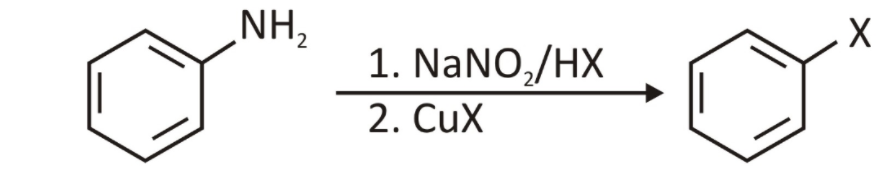
Diazonium salts are organic compounds containing three nitrogen atoms and an alkyl or an aryl (benzene ring) group on the opposite side. The diazonium salts are between the azo dyes and the dye salts (colouring agents). They are referred to as salts due to the presence of a double nitrogen atom (diazo), which is often observed in ionic salts when chloride molecules take the nitrogen atom’s place. The entire procedure for producing diazonium salts is relatively simple.
Diazonium salts are referred to as diazonium compounds. Diazonium salts are organic molecules with the formula R–N2+X–, where R is an alkyl or aryl group, X is any halogen or organic compound. Aryl diazonium salts are frequently used as intermediates to synthesise organic compounds.
Arenediazonium salts are a form of the chemical arene diazonium. In the term ‘Diazonium salts,’ ‘di’ denotes two, aza represents nitrogen, and onium represents the compound’s ionic nature. As a result, ionic substances containing N≡N are referred to as diazonium salts.
The diazotisation or dissociation of an organic compound, most commonly primary aromatic amines, results in the formation of diazonium salts. Diazonium groups are extremely unstable and so cannot be stored. As a result, we usually use them instantly after they’ve been prepared. Nitrous acid reacts with aromatic amines to form the most stable diazonium salt.
Aniline (aromatic amine) and nitrous acid produce the diazonium salt. Nitrous acid is a highly hazardous gas. NaNO2 and a mineral acid are typically prepared throughout the reaction in which they are used.
This is vital since the produced diazonium salts can be converted into an infinite lot of excellent functional groups.
The term “versatile” can be applied to any process that uses a single raw material and can be converted into seven different end products.
The diazonium salt reactions can be broadly classified into two types: Sandmeyer’s reactions, among many other responses.
One method of transforming diazonium salts is to treat them with different copper compounds. Sandmeyer’s reactions are named after Traugott Sandmeyer, who discovered them in 1884.
Three significant examples include the following:
According to this reaction, Aryl radicals are oxidised to aryl cations, which are subsequently attacked by nucleophiles.
Substitution occurs without copper if a strong nucleophile is present and the mixture is heated sufficiently:
C6H5N2Cl + KI →C6H5I + KCl + N2
C6H5N2Cl + C6H5OH→C6H5 –N2–C6H4 –OH
Diazotization is the chemical process of converting a primary aromatic amino group into its diazonium salt. Typically, these diazonium salts are prepared by reacting an aromatic amine, including nitrous acid, with another compound. However, it has been discovered that the diazonium group is extremely unstable under normal settings. As a result, it is not usually stored; instead, it is used immediately after preparation. Therefore, nitrous acid and aromatic amines are commonly used to synthesise diazonium salts.



 Profile
 Settings
 Refer your friends
 Sign out