The depression of the freezing point is a colligative property due to the addition of solute molecules to any solvent. To be very precise, the depression of freezing point is a term that refers to the lowering of the freezing point of solvents due to the addition of solute molecules to it. Due to a decrease in temperature, a substance starts freezing, and its intermolecular forces take over, arranging themselves in a pattern and eventually turning into solid.
Let us take an example to have a better understanding. When we keep water to cool, if the temperature is below the freezing point of water, the hydrogen bonding begins to stick more and, thus, result in the formula for the depression of freezing point:
△Tf = i x Kf x m
Here, △Tf stands for depression of freezing point, i stands for Van’t Hoff Factor, Kf stands for cryoscopic constant, and m represents molality.
We can determine the molar mass of a given solute from the above-written formula. Also, we can measure the degree to which a solute dissociates into a solvent.
We can obtain the freezing point of a solution if the chemical potential of a pure liquid solvent reaches that of a pure solid solvent.
The calculation of the molecular mass of a solute using depression in freezing point is as follows:
M = (1000 × Kf × w2) ÷ (∆Tf × w1)
Here, w2 stands for the weight of solute, w1 stands for the weight of solvent, Kf stands for molal depression constant, and ∆Tf stands for depression in the freezing point.
There can be many reasons why the depression of the freezing point of a solvent occurs when we add solute molecules to it. Let us take a close look at those reasons:
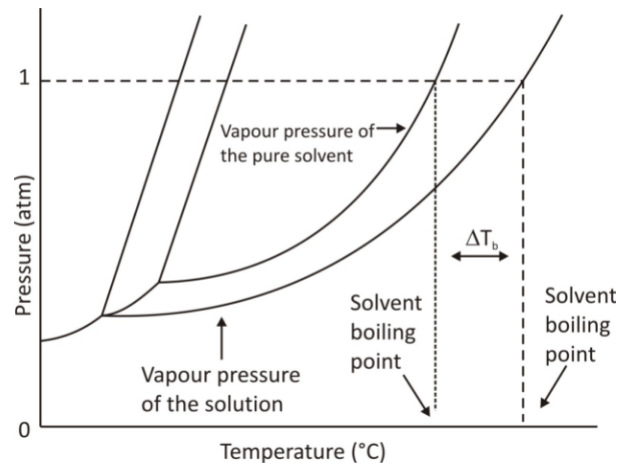
To understand the effects of solutes on the physical properties, we need to understand the graph given below:
The graph represents the pressure and temperature of the standard boiling point and freezing points of a solvent and the boiling and freezing points of a solution. You can see at 1atm of pressure, the freezing point decreases.
Many factors affect the depression of freezing point, which are as follows:
In the process of freezing, a substance changes its state from liquid to solid. When a substance is in a liquid state, its molecules are loosely bound, and the intermolecular forces are also less than that of solids.
When a substance is in a liquid state, the molecules are in a continuous motion. But when the substance freezes, it loses its thermal energy and comes closer to each other.
The temperature remains the same during the freezing process, and it changes from liquid to crystalline solid state. The energy gets released during this freezing process, as when the molecules are in a liquid state, it is in continuous motion. When it changes to solid, it releases energy.
The depression of the freezing point is a colligative property due to the addition of solute molecules to any solvent. To be very precise, the depression of freezing point is a term that refers to the lowering of the freezing point of solvents due to the addition of solute molecules to it. Due to a decrease in temperature, a substance starts freezing, and its intermolecular forces take over, arranging themselves in a pattern and eventually turning into solid.



 Profile
 Settings
 Refer your friends
 Sign out