The equilibrium constant, K, defines the relationship between the reactants and products of a reaction at equilibrium. A reaction reaches equilibrium when the rate of forwarding reaction and backward reaction is equal. Concentrations of all reactants and all the products are constant at equilibrium. A similar constant called reaction quotient Q is used when the reactants are not in equilibrium. It is equal to Kc.
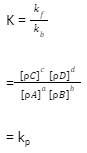
The equilibrium constant is the ratio of the concentration of products at equilibrium, raised to their stoichiometric coefficients, to the concentration of reactants at equilibrium, raised to their stoichiometric coefficients.
For example, a reversible reaction:
aA + bB = cC + dD
Then the equilibrium constant K is equal to:
where,
[A] = Equilibrium Concentration of A
[B] = Equilibrium Concentration of B
[C] = Equilibrium Concentration of C
[D] = Equilibrium Concentration of D
For reactions that involve gases, the equilibrium constant is written in terms of the partial pressure of the gases.
Here Kp defines the equilibrium constant in terms of partial pressures.
Understanding the characteristics of equilibrium constant are important because they help calculate the equilibrium constant.
For example, if for the reaction A + B = C + D
the equilibrium constant is K
Then, for the reaction 3A + 3B = 3C + 3D
the equilibrium constant is K3
For example:
A mixture of 0.100 M NO, 0.050 M H2, 0.100 M H2O was allowed to reach equilibrium (initially, the reaction didn’t have any N2). At equilibrium, the concentration of NO was found to be 0.062 M. Find the value of the equilibrium constant K for the reaction:
2 NO + 2 H2 = N2 + 2 H2O
Solution:
The reaction’s equilibrium expression is
NO | H2 | N2 | H2O | |
Initial Concentration | 0.100 | 0.0500 | 0 | 0.100 |
Change in concentration | -2x | -2x | +x | +2x |
Equilibrium Concentration | 0.062 |
The difference in NO concentration was (0.062 M – 0.100M) = – 0.038 M. As a result, -2x = -0.038 and x = 0.019. It is important to note that the negative sign indicates a declining concentration, not a negative concentration.
NO | H2 | N2 | H2O | |
Initial Concentration | 0.100 | 0.0500 | 0 | 0.100 |
Change in concentration | -0.038 | -0.038 | +0.019 | +0.038 |
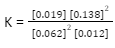
Equilibrium concentration | 0.062 | 0.012 | 0.019 | 0.138 |
Solve for Kc by substituting the equilibrium concentrations into the equilibrium expression.
= 650 or 6.5 X 10²
The equilibrium constant K defines the relationship between product and reactant in an equilibrium. Calculating the equilibrium concentration is easy if the values are given. The law of chemical equilibrium states that there is no change in the concentration of reactants or products after achieving a certain state, i.e. the equilibrium. It is possible to attain chemical equilibrium from either direction (forward or backwards). It is dynamic, which means the rates are equal without any change in the concentration of products and reactants.This equilibrium constant changes with changes in temperature, pressure and concentration.A catalyst can only increase or decrease the time of attaining the equilibrium state without any change in its concentration. Moreover, if the concentration is decreased, the reactants change the balance and go backwards. On the other hand, if the product concentration increases, then the equilibrium shifts towards the backward position, and if it decreases, it goes towards the forward path.



 Profile
 Settings
 Refer your friends
 Sign out