Access free live classes and tests on the app
Download
+
Unacademy's Blog!
Login Join for Free
avtar
  • ProfileProfile
  • Settings Settings
  • Refer your friendsRefer your friends
  • Sign outSign out
  • Terms & conditions
  • •
  • Privacy policy
  • About
  • •
  • Careers
  • •
  • Blog

© 2023 Sorting Hat Technologies Pvt Ltd

Challenge Yourself Everyday Attempt 2023’s and previous year’s JEE Main Download Important Formulas pdf Attempt Free Test Series for JEE Main 2023

Trending Topics

  • JEE Main 2024
  • JEE Main Rank Predictor 2024
  • JEE Main Mock Test 2024
  • JEE Main 2024 Admit Card
  • JEE Advanced Syllabus
  • JEE Preparation Books
  • JEE Notes
  • JEE Advanced Toppers
  • JEE Advanced 2022 Question Paper
  • JEE Advanced 2022 Answer Key
  • JEE Main Question Paper
  • JEE Main Answer key 2022
  • JEE Main Paper Analysis 2022
  • JEE Main Result
  • JEE Exam Pattern
  • JEE Main Eligibility
  • JEE College predictor
[wp_login_wall media_id="424566" text_before_login="Download JEE Main PYQs" text_after_login="Download JEE Main 2022 Question Papers"]

JEE Coaching Centres

  • JEE Coaching in Nagpur
  • JEE Coaching in Ranchi
  • JEE Coaching in Gorakhpur
  • JEE Coaching in Bhubaneswar
  • JEE Coaching in Vijayawada
  • JEE Coaching in Dehradun
  • JEE Coaching in Indore
  • JEE Coaching in Gurugram
  • JEE Coaching in Muzaffarpur
  • JEE Coaching in Varanasi
  • JEE Coaching in Jammu
  • JEE Coaching in Kolhapur
  • JEE Coaching in Bikaner
  • JEE Coaching in Delhi Lajpat Nagar
Predict your JEE Rank . [wp_custom_style style=".side-btn-second{margin: 1px 0px;}"][wp_custom_script script="document.querySelector('.targetTopBtn').onClick = topFunction; function topFunction() { window.scrollTo({ top: 0, behavior: 'smooth' }) }"][wp_custom_style style=".side-btn-second{margin: 1px 0px;} .elementor-element.elementor-element-dcb2b31{display: none !important;}"]
Challenge Yourself Everyday Attempt 2023’s and previous year’s JEE Main Download Important Formulas pdf Attempt Free Test Series for JEE Main 2023

Trending Topics

  • JEE Main 2024
  • JEE Main Rank Predictor 2024
  • JEE Main Mock Test 2024
  • JEE Main 2024 Admit Card
  • JEE Advanced Syllabus
  • JEE Preparation Books
  • JEE Notes
  • JEE Advanced Toppers
  • JEE Advanced 2022 Question Paper
  • JEE Advanced 2022 Answer Key
  • JEE Main Question Paper
  • JEE Main Answer key 2022
  • JEE Main Paper Analysis 2022
  • JEE Main Result
  • JEE Exam Pattern
  • JEE Main Eligibility
  • JEE College predictor
[wp_login_wall media_id="424566" text_before_login="Download JEE Main PYQs" text_after_login="Download JEE Main 2022 Question Papers"]

JEE Coaching Centres

  • JEE Coaching in Nagpur
  • JEE Coaching in Ranchi
  • JEE Coaching in Gorakhpur
  • JEE Coaching in Bhubaneswar
  • JEE Coaching in Vijayawada
  • JEE Coaching in Dehradun
  • JEE Coaching in Indore
  • JEE Coaching in Gurugram
  • JEE Coaching in Muzaffarpur
  • JEE Coaching in Varanasi
  • JEE Coaching in Jammu
  • JEE Coaching in Kolhapur
  • JEE Coaching in Bikaner
  • JEE Coaching in Delhi Lajpat Nagar
Predict your JEE Rank . [wp_custom_style style=".side-btn-second{margin: 1px 0px;}"][wp_custom_script script="document.querySelector('.targetTopBtn').onClick = topFunction; function topFunction() { window.scrollTo({ top: 0, behavior: 'smooth' }) }"][wp_custom_style style=".side-btn-second{margin: 1px 0px;} .elementor-element.elementor-element-dcb2b31{display: none !important;}"]
JEE Main 2026 Preparation: Question Papers, Solutions, Mock Tests & Strategy Unacademy » JEE Study Material » Chemistry » Azeotropes Based on the Number of Constituents
Challenge Yourself Everyday Attempt 2023’s and previous year’s JEE Main Download Important Formulas pdf Attempt Free Test Series for JEE Main 2023

Trending Topics

  • JEE Main 2024
  • JEE Main Rank Predictor 2024
  • JEE Main Mock Test 2024
  • JEE Main 2024 Admit Card
  • JEE Advanced Syllabus
  • JEE Preparation Books
  • JEE Notes
  • JEE Advanced Toppers
  • JEE Advanced 2022 Question Paper
  • JEE Advanced 2022 Answer Key
  • JEE Main Question Paper
  • JEE Main Answer key 2022
  • JEE Main Paper Analysis 2022
  • JEE Main Result
  • JEE Exam Pattern
  • JEE Main Eligibility
  • JEE College predictor
[wp_login_wall media_id="424566" text_before_login="Download JEE Main PYQs" text_after_login="Download JEE Main 2022 Question Papers"]

JEE Coaching Centres

  • JEE Coaching in Nagpur
  • JEE Coaching in Ranchi
  • JEE Coaching in Gorakhpur
  • JEE Coaching in Bhubaneswar
  • JEE Coaching in Vijayawada
  • JEE Coaching in Dehradun
  • JEE Coaching in Indore
  • JEE Coaching in Gurugram
  • JEE Coaching in Muzaffarpur
  • JEE Coaching in Varanasi
  • JEE Coaching in Jammu
  • JEE Coaching in Kolhapur
  • JEE Coaching in Bikaner
  • JEE Coaching in Delhi Lajpat Nagar
Predict your JEE Rank . [wp_custom_style style=".side-btn-second{margin: 1px 0px;}"][wp_custom_script script="document.querySelector('.targetTopBtn').onClick = topFunction; function topFunction() { window.scrollTo({ top: 0, behavior: 'smooth' }) }"][wp_custom_style style=".side-btn-second{margin: 1px 0px;} .elementor-element.elementor-element-dcb2b31{display: none !important;}"]

Azeotropes Based on the Number of Constituents

Azeotropes are made up of two, three, or more, and they may be homogeneous or heterogeneous in composition. Know more about it here.

Table of Content
  •  

An azeotrope is a liquid mixture with a constant boiling point and the same vapour composition as the liquid. Using distillation, we may separate elements that would normally be mixed in an ideal solution since one component is often more volatile. However, the vapour and liquid concentrations are the same if the combination forms an azeotrope, making separation difficult. Different liquids are combined to create an azeotrope. Their combination can have a lower boiling point than either of the components. Azeotropes are formed when distillation cannot change a portion of the liquid. In most cases, Fractionation, or repeated distillation in stages (thus the term ‘fractional’) may be used to extract components from solutions. Distillation is when the more volatile components evaporate and are separated from the less volatile components, resulting in two distinct solutions.

Azeotropic mixture explanation

When it comes to azeotropes, you won’t be able to change their size by distillation. This is because when the mixture is heated , it emits a fume with the same quantity of elements as the uncooked mixture, which explains this. As a result, they are “stationary limit mixtures.” So in this particular instance, fractional distillation cannot be utilised to separate the constituents of a combination.

Ideal solutions vs azeotropes

Ideal solutions are composed of a homogeneous set of components with distinct physical properties. Because the interactions between solute and solvent molecules are the same as if each molecule were alone, Raoult’s law supports these solutions. Benzene and toluene, for example, are good options. 

On the other hand, azeotrope does not fit this description since the component ratio of a vapourised solution is similar to that of the vaporised solution when boiling. Hence, an azeotrope may be characterised as a solution with the same liquid composition in its vapour. 

As you may expect, distilling such a substance is challenging. However, since pure ethanol is almost nonexistent, the most concentrated form of ethanol is an azeotrope, 95.6 percent ethanol by weight.

Azeotrope may be found at a boiling point specific to the component in question. The azeotrope is located at a specified boiling point at point M. For example, imagine a mixture of 64 percent D and 32 percent water at point Z. Water + azeotrope would be the solution if the same solution comprised less than 64%. 

Component D+Azeotrope would be the answer if the percentage were more than 64%. Temperatures higher or lower would result in a different concentration of C or D. Hence an azeotrope can only exist in one temperature range.

Additionally, since the azeotrope’s boiling point is higher than the sum of its constituent parts, it is referred to as a negative azeotrope. On the other hand, the boiling point of a positive azeotrope is lower than that of any of its constituents, as one would assume.

Azeotropic Mixture types

Maximum boiling azeotropes

The positive azeotropes are the mixtures of azeotropes that show large positive deviations. Here look at the different points related to the positive azeotropes:

  • The boiling points for such azeotropes are less than the constituting boiling points. 
  • The types of mixtures are the mixtures that spill the most vapour pressure with the lowest boiling point.
  • Example: Suppose the azeotropic mixture is 96% & contains 4% water, then it is a positive azeotrope. It shows the sizable positive deviation as per Raoult’s law.

Minimum boiling azeotropes 

A mixture, i.e., zeotropic, has the same boiling points with consistency: 

  • The presence of the same concentration will help in preventing the separation.
  • The azeotropes only get formed when there is an occurrence of vapour with the heating of a mixture.
  • The variety deviation with Raoult’s Law specifies both dew and bubble points.
  • And if the mixture gets formed with the non-azeotropic, these circumstances are known as azeotropic.

Homogeneous Azeotropes

These are azeotropes in which all of the components are highly soluble.

There are several examples of homogeneous azeotropes, including ethanol and water.

Heterogeneous Azeotropes

Heterogeneous azeotropes are found in mixed constitutions and are not miscible.

Conclusion

Azeotropes mix at least two liquids with the same concentration at the liquid and vapour phases. Therefore, azeotropes do not obey Raoult’s Law. Though the name azeotrope is currently used extensively to express this occurrence, the phrase “constant boiling point mixture” is more prevalent in the earlier scientific books. 

It suggests these mixes are not ideal solutions and demonstrate divergence from Raoult’s Law. In azeotropic mixes, one component has a greater or lower boiling point than another. In these mixtures, the mole fractions of the components in the liquid and vapour phases are the same. As a result, fractional distillation will not work to separate them.

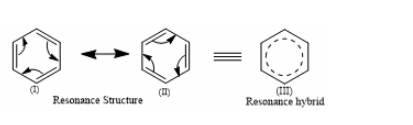
Three C-C single bonds with a bond length of 1.54 A and three C=C double bonds with a bond length of 1.34A are found in the aforementioned structures (I) and (II). However, it was discovered that all six carbon and carbon bonds are identical, and a 1.39 A intermediate C-C and C+C bond was discovered. The poor reactivity of halogen in vinyl bromide can be explained further by the phenomena of resonance.

Resonance energy is the difference between the real molecule and the more stable canonical form. 

Application of resonance effect 

The high utility of resonance theory and its worth comes from the fact that it maintains the simple and unsophisticated form of structural representation. 

  • Stability of carbocation 

The carbocation that conjugates a positive charge with a double bond tends to be more stable. The allylic carbocation is more stable than the comparable alkyl cation because of the resonance structure. The resonance structures are formed when the negative electrons of the conjugated double bonds are delocalised, which increases their stability. The stability will be great if the resonating structure is great. 

  • Carbanion of stability 

The availability of double bonds or an aromatic ring will enhance the anion’s stability around the negatively charged atom because of resonance.  

A point to be noted: the bigger the resonance structure, the more stable it will be. 

Due to resonance, the negative charge on benzyl carbanion disperses over additional carbon atoms, making it more stable than ethyl carbanion.  

  • Stability of free radicals 

Due to depolarisation of the unpaired electrons across the system, simple alkyl radicals are less stable allylic and benzylic forms of free radicals.  

Mesomeric effect vs resonance effect 

  • Resonance effect can be defined as the process in which two or more structures can be written for the real structure of a molecule, but none of them fully explains all characteristics of molecules. Substituents or functional groups in a chemical molecule cause the mesomeric effect, denoted by the letter M.  
  • Delocalisation of electrons in a system is known as resonance whereas the mesomeric effect is known as the resonance effect. It is a long-term impact that is reliable on the substituents or functional groups in a chemical compound. 
  • The +R (electron releasing) group is equal to the +M effect, while the –R (electron attracting) group is equal to the –M effect.

Principle of resonance 

  • The most fundamental resonance is the one that is generated with the least charge.
  • The resonance of a full octet is more substantial than that of a partial octet. The most essential forms are those in which positive charges operate on the least electronegative atom. 
  • The resonance structure with the greatest covalent bond is the most significant. 

Resonance effect vs inductive effect 

  • An inductive effect occurs when the polarisation of one link is caused by another link. On the other hand, the resonance effect occurs when two or more structures may be described for molecules, but none can describe all the characteristics of a molecule on their own. 
  • The difference in electronegativity between two atoms in a bond affects the inductive effect directly, whereas the number of resonant structures affects the stability. 

Occurrence of resonance 

  • A pi bond conjugated with the other pi bond
  • A pi bond conjugated with a negative charge
  • A pi bond with a positive charge conjugated to it 
  • A negative charge conjugated with the lone pair or a positive charge conjugated with a lone pair 
  • A pi bond conjugated with a lone pair or a free radical

Conclusion 

In chemistry, resonance is an intramolecular electrical phenomenon in which the location of a pi bond(s) or a nonbonding electron changes (also called a sigma bond). In this procedure, however, the location of an atom is changed by modifying the pi electrons’ position or the non-bonding electrons’ position.

Resonance is a property of organic compounds. In organic chemistry, the delocalised electrons inside a specific compound when a single Lewis structure does not express the bond are referred to as resonance. To portray delocalised electrons in an ion or molecule, several structures known as resonance can be used. 

faq

Frequently Asked Questions

Get answers to the most common queries related to the JEE Examination Preparation.

How do you recognise azeotropes?

Ans : Azeotropes are a blend of at least two different liquids. Their c...Read full

What are azeotropes, for example?

Ans : The azeotropic mixture combines two or more liquids with a constant boil...Read full

How are azeotropes formed?

Ans : Any mixture that deviates from Raoult’s rule (the equality of comp...Read full

What is meant by minimum boiling azeotrope?

Ans : Positive or Negative: A positive azeotrope or minimum-boiling azeotrope ...Read full

Which form of deviation is exhibited by the ideal solution?

Ans : Ideal solutions follow Raoult’s Law at every temperature and concentration, whereas non-ideal solutions ...Read full

Ans : Azeotropes are a blend of at least two different liquids. Their combination may either have a greater boiling point than each of the components, or they can have a lower boiling point. Azeotropes develop when the fraction of the liquids cannot be changed by distillation.

Ans : The azeotropic mixture combines two or more liquids with a constant boiling point. The most common example of an azeotropic combination is a mixture of ethanol and water in the ratio of 95.6:4.4. It boils at a temperature of 78.5∘C.

Ans : Any mixture that deviates from Raoult’s rule (the equality of compositions in the liquid and vapour phases) and Dalton’s law (the equality of pressures for the total pressure to be equal to the sum of the partial pressures in real mixes) will have azeotropes; they can’t otherwise arise.

Ans : Positive or Negative: A positive azeotrope or minimum-boiling azeotrope arises when the boiling point of the combination is lower than that of any of its components. A negative azeotrope or maximum-boiling azeotrope arises when the boiling point of the combination is greater than that of any of its components.

Ans : Ideal solutions follow Raoult’s Law at every temperature and concentration, whereas non-ideal solutions depart from Raoult’s Law at various concentrations and temperatures. There are two sorts of departures of Raoult’s Law; the positive deviation is when the vapour pressure is larger than predicted.

Challenge Yourself Everyday
Attempt 2023’s and previous year’s JEE Main
Download Important Formulas pdf
Attempt Free Test Series for JEE Main 2023

Trending Topics

  • JEE Main 2024
  • JEE Main Rank Predictor 2024
  • JEE Main Mock Test 2024
  • JEE Main 2024 Admit Card
  • JEE Advanced Syllabus
  • JEE Preparation Books
  • JEE Notes
  • JEE Advanced Toppers
  • JEE Advanced 2022 Question Paper
  • JEE Advanced 2022 Answer Key
  • JEE Main Question Paper
  • JEE Main Answer key 2022
  • JEE Main Paper Analysis 2022
  • JEE Main Result
  • JEE Exam Pattern
  • JEE Main Eligibility
  • JEE College predictor

JEE Coaching Centres

  • JEE Coaching in Nagpur
  • JEE Coaching in Ranchi
  • JEE Coaching in Gorakhpur
  • JEE Coaching in Bhubaneswar
  • JEE Coaching in Vijayawada
  • JEE Coaching in Dehradun
  • JEE Coaching in Indore
  • JEE Coaching in Gurugram
  • JEE Coaching in Muzaffarpur
  • JEE Coaching in Varanasi
  • JEE Coaching in Jammu
  • JEE Coaching in Kolhapur
  • JEE Coaching in Bikaner
  • JEE Coaching in Delhi Lajpat Nagar
Predict your JEE Rank
.
Challenge Yourself Everyday
Attempt 2023’s and previous year’s JEE Main
Download Important Formulas pdf
Attempt Free Test Series for JEE Main 2023

Trending Topics

  • JEE Main 2024
  • JEE Main Rank Predictor 2024
  • JEE Main Mock Test 2024
  • JEE Main 2024 Admit Card
  • JEE Advanced Syllabus
  • JEE Preparation Books
  • JEE Notes
  • JEE Advanced Toppers
  • JEE Advanced 2022 Question Paper
  • JEE Advanced 2022 Answer Key
  • JEE Main Question Paper
  • JEE Main Answer key 2022
  • JEE Main Paper Analysis 2022
  • JEE Main Result
  • JEE Exam Pattern
  • JEE Main Eligibility
  • JEE College predictor

JEE Coaching Centres

  • JEE Coaching in Nagpur
  • JEE Coaching in Ranchi
  • JEE Coaching in Gorakhpur
  • JEE Coaching in Bhubaneswar
  • JEE Coaching in Vijayawada
  • JEE Coaching in Dehradun
  • JEE Coaching in Indore
  • JEE Coaching in Gurugram
  • JEE Coaching in Muzaffarpur
  • JEE Coaching in Varanasi
  • JEE Coaching in Jammu
  • JEE Coaching in Kolhapur
  • JEE Coaching in Bikaner
  • JEE Coaching in Delhi Lajpat Nagar
Predict your JEE Rank
.
Company Logo

Unacademy is India’s largest online learning platform. Download our apps to start learning


Starting your preparation?

Call us and we will answer all your questions about learning on Unacademy

Call +91 8585858585

Company
About usShikshodayaCareers
we're hiring
BlogsPrivacy PolicyTerms and Conditions
Help & support
User GuidelinesSite MapRefund PolicyTakedown PolicyGrievance Redressal
Products
Learner appLearner appEducator appEducator appParent appParent app
Popular goals
IIT JEEUPSCSSCCSIR UGC NETNEET UG
Trending exams
GATECATCANTA UGC NETBank Exams
Study material
UPSC Study MaterialNEET UG Study MaterialCA Foundation Study MaterialJEE Study MaterialSSC Study Material

© 2026 Sorting Hat Technologies Pvt Ltd

Unacademy's Blog!

Share via

COPY