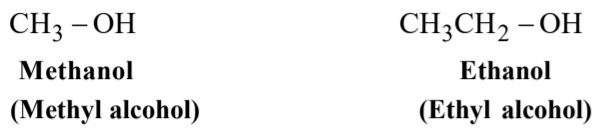
The organic compounds, which are obtained by replacing one or more hydrogen atoms with one or more hydroxyl groups (-OH) linked to saturated carbon atoms, are called Alcohols. For example, methyl alcohol (methanol) and ethyl alcohol (ethanol) are two industrially important Alcohols.
Classification of Alcohols
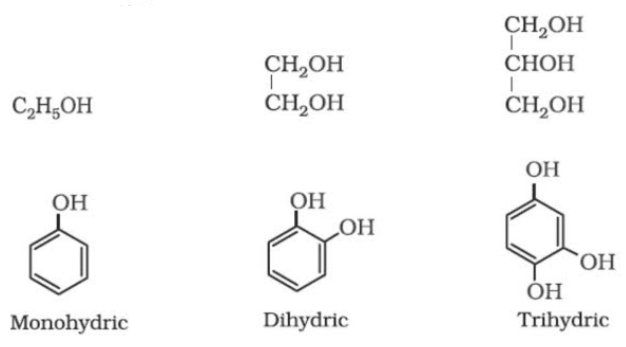
They can further be categorized as-
-OH group attached at sp3 carbons:
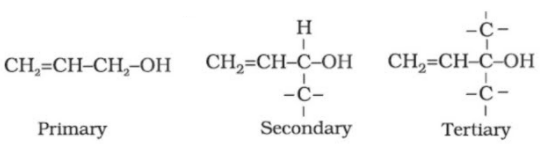
a) Primary (10), Secondary (20), and Tertiary (30),
b) Allylic alcohol, the hydroxyl (-OH) group is linked to sp3 hybridized carbon, i.e., next to allylic carbon (i.e., the carbon-carbon double bond).
c) Benzylic alcohol, the hydroxyl (-OH) group is linked to the sp3 hybridized carbon atom which is next to an aromatic ring.
-OH group attached at sp2 carbons:
Vinylic alcohol, -OH group bonded to a carbon-carbon double bond (i.e., to a vinylic carbon or to an aryl carbon).
IUPAC System of Nomenclature
According to the IUPAC system of nomenclature, the alcohols are called Alkanols as the ‘-e’ of alkane in the derivative of corresponding alkanes are replaced by ‘-ol’.
Various steps in nomenclature are:
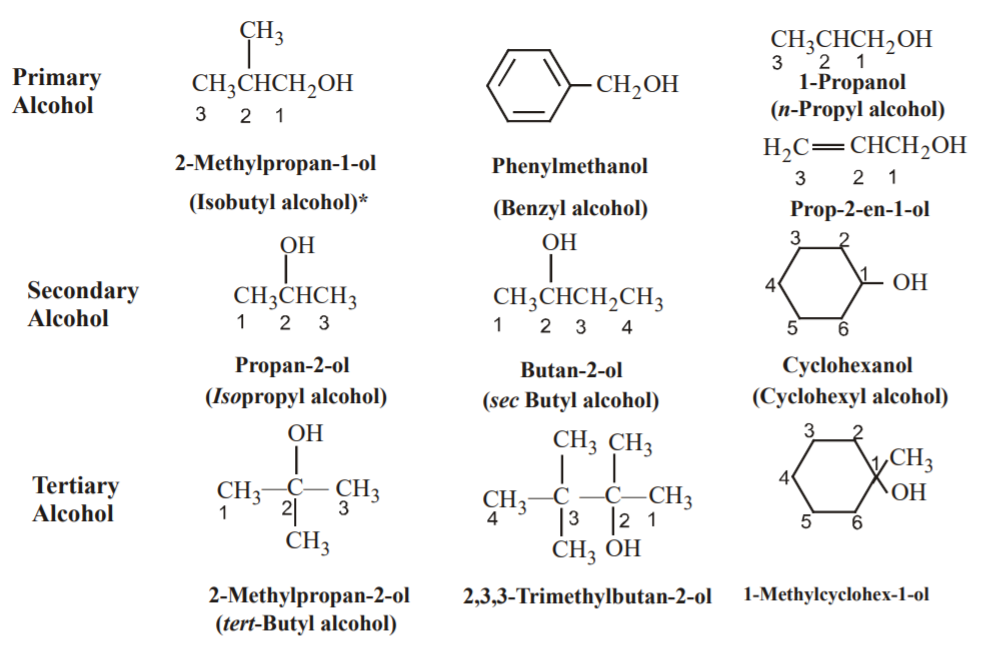
Some Common Alcohols and their names
Structure
Physical Properties of Alcohol
1° > 2° > 3°
H2O is a better proton donor or stronger acid than alcohol.
ALCOHOL CONSUMPTION
Factors affecting alcohol consumption and alcohol-related harm
Alcohol Metabolism
The first step in the body used to break down alcohol is Alcohol dehydrogenase. Ethanol is highly toxic to the body and is found in alcoholic drinks.
Alcohol dehydrogenase is a zinc-based enzyme leading to the conversion of ethanol alcohol into acetaldehyde. Alcohol dehydrogenase is located in the cytosol of liver and stomach cells. The main enzyme for alcohol metabolism is ADH.
Enzyme Mechanism
The general mechanism shows that the ethanol + NAD forms acetaldehyde + NADH. In other words, ethanol (it is any carbon chain with carbon attached to an OH group) is oxidized into acetaldehyde (it is any carbon chain with the terminal carbon forming a double bond with oxygen) and the hydrogen atoms are added to NAD.
The active site of alcohol dehydrogenase includes a serine, histidine, isoleucine and zinc stabilized by two cysteines and a histidine.
Zinc binds to the oxygen in the alcohol. The NAD gets bound to the isoleucine. The two main steps in the alcohol hydrogenase mechanism are:
In step 1, histidine removes a hydrogen atom from NAD, and then it removes hydrogen from serine as a result to which it takes the hydrogen from the OH on the alcohol.
In step 2, a double bond is formed due to the presence of electrons in the oxygen with carbon. To the 6-membered ring on NAD, the electrons in the carbon-hydrogen bond are added (with the hydrogen) leading to the formation of NADH and acetaldehyde.
USE OF ALCOHOL
METHANOL:
a) It is used in automotive radiators as an anti-freeze.
b) It is used as a fuel for internal combustion in engines.
c) It is used as an additive in petrol to improve combustion.
d) It is used as a solvent in inks, dyes, resins, etc.
e) It is also used in the pharmaceutical industry.
f) It is used as a chemical feedstock.
g) Methanol is used in the manufacturing of paints, plastics, cosmetics, textiles, etc.
ETHANOL:
a) Ethanol is considered an alcoholic drink. Its content is present in beers and wines.
b) It is used as transportation fuel or is mixed with petrol as it burns with smokeless clean flame by undergoing complete combustion.
c) It is used in paints, cosmetics, inks, perfumes, etc.
d) It is also used as a solvent.
e) Any organic compound which is not soluble in water gets easily dissolved in ethanol.
f) It has antiseptic properties.
g) It slows or stops the growth of microorganisms by denaturation process, hence, is used in sanitisers and hand wipes.
PROPANOL:
a) It is used as a solvent.
b) It is also used in the pharmaceutical industry.
c) It also has antiseptic properties.
BUTANOL:
a) Its use is increased as a biofuel which is produced from the fermentation of sugar and carbohydrates.
b) It is used as a solvent in perfumes, paints, cosmetics, inks, etc.
c) Butanol is used in manufacturing butyl ethanoate, an ester. It is also used as a synthetic fruit flavor which is used in the confectionery and food industry.
We have seen how alcohols are molecules that include one or more hydroxyl (-OH) groups directly connected to a carbon chain, as opposed to other compounds. Generally speaking, alcohols in the free-form are not found in nature; instead, they are found mostly in the essential or volatile oils extracted from the flowers, leaves, and stems of various plants.



 Profile
 Settings
 Refer your friends
 Sign out