NATURE OF ROOTS OF QUADRATIC EQUATION:
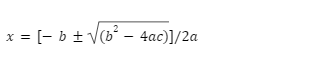
There are several roots of the quadratic equation. These natures of roots are dependent upon the discriminant of the quadratic equation. The discriminant of a quadratic equation is evaluated by (b2-4ac) postulated by the Shridharacharya formula. Based on the discriminant values, there are five natures of roots. They are:
- Real roots: An equation is the real root of a quadratic Equation; if the value is a real number, that condition can be achieved only if the discriminant of that quadratic equation is greater than zero, i.e., (b2-4ac) > 0.
- Imaginary roots: An equation is said to be the imaginary roots of quadratic equations, only if the discriminant of the equation is less than zero, i.e., b2-4ac < 0.
- Rational quadratic Equation: A root of a quadratic equation is rational if the quadratic equation’s discriminant is a perfect square.
- Irrational quadratic Equation: In contrast to the rational quadratic equation, the irrational quadratic equation is defined as a quadratic Equation whose discriminant is not a perfect square.
- Equal roots: A quadratic equation is said to be the equal nature of roots; only if the discrimination of the quadratic equation is equal to zero (b2-4ac=0) then it is termed as a real and equal root.
EXAMPLES OF ROOTS:
- Real roots of quadratic Equation:
x2-5x+6=0
Equating the formula into the discriminant of a quadratic equation,
b2-4ac=(-5)2-4*1*6=25-24=1
Using the Sridharacharya formula,
x=[-b(b2-4ac)]/2a
x=[-(-5)1]/2
x1=[-(-5)+1]/2=6/2=3
x2=[-(-5)-1]/2=4/2=2
Hence, the roots are 3 and 2, which are real roots of the quadratic equation.
- Imaginary roots of quadratic Equation:
x2-6x+11=0
Equating the formula into the discriminant of a quadratic equation,
b2-4ac=(6)2-4*1*11=36-44=-8
Using the Sridharacharya formula,
x=[-b(b2-4ac)]/2a
x=[-(6)(-8)]/2
x1=[-(6)+(-8)]/2=[-6+8i]/2=2[-3+2i]/2=-3+2i
x1=[-(6)-(-8)]/2=[-6-8i]/2=2[-3-2i]/2=-3-2i
Therefore, the roots are (-3+2i) and (-3-2i), which are imaginary roots of quadratic equations.
CONCLUSION:
The primitive root is the smallest positive power that can rise over an integer, which is comparatively prime to another integer. The outcome of a primitive root can be a quadratic residue or a non-quadratic recipe. In either case, the quadratic equation must be simplified with the help of the Sridharacharya formula. The Sridharacharya formula equates a discriminant of the quadratic equation, which categorises the roots into five natures of roots, namely real roots, imaginary roots, rational roots, irrational roots, and equal roots. To better understand the topic of primitive roots in quadratic equations, one must have the basic knowledge of the prime numbers and the power raised to the numbers.



 Profile
 Settings
 Refer your friends
 Sign out