Objective functions are the most efficient way to solve and represent linear programming optimization problems. It can take the form Z=ax + by where, a and b are limitations, and x and y are variables. x and y are also known as the decision variables and must be maximized and minimized. Alternatively, it can be of the form Z=f(xi).
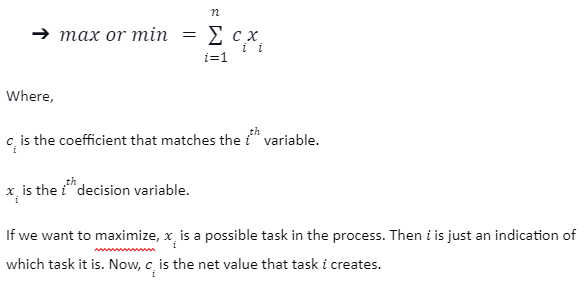
Generally, we use this function to find the maximum or minimum of any given data. We can write its formula as:
Some of the most used terms that make understanding of this concept easy and efficient are:
Linear Programming: It is the process of achieving the best outcome (maximum profit or lowest cost) in a mathematical form whose elements are represented by linear relationships. Linear programming is a particular case of mathematical programming.
Optimization Problem: An optimization problem is a problem in which a linear function has to be maximized or minimized subject to certain limitations set by a collection of linear inequalities.
Decision Variables: The decision variables are the variables that will decide my output. For example, in a business, the resources required, people assigned to work, and time allotted are all decision variables. In the form Z=ax+by , x and y are the decision variables.
Constraints: The limitations in the set of values that the variables x and y can take are called the constraints of the objective function. The constraints x>0,y>0 are the most basic constraints to show positive numbers.
Feasible Region: A feasible region is an area defined by a set of coordinates that satisfy all the constraints, including non-negative constraints x>0,y>0 of a linear programming problem. It’s an optimization technique.
Feasible Solution: It is the value to the variables that lie in the feasible region or on the boundary of the feasible area. It satisfies all restrictions and inequalities.
Optimal Value: Optimal Value is a value from the set of feasible solutions with the maximum efficiency—for example, minimum cost, the maximum profit, or the optimal use of resources.
The objective function in the linear programming problem has two most important theorems.
Suppose R is the feasible region for a linear programming problem and is the objective function. In that case, when R has an optimal value, it must occur at a corner point of the feasible region.
Suppose R is the feasible region for a linear programming problem and is the objective function.Under those circumstances, if R is bounded, the objective function Z will have both a maximum and a minimum value for R, and each of these will occur at a corner point of the feasible area.
The most commonly used real-life problems of linear programming are :
In today’s world, everyone thrives on getting the most output with minor input, and optimization gives them the most efficient answer. As a result, the objective function is used across the industry, commerce, management, applied sciences to solve numerous real-life problems.


 Profile
 Settings
 Refer your friends
 Sign out