We will study the fundamentals of determinants and the calculation of determinants of a matrix along with the representation of a matrix. We will take examples to understand the fundamentals of determinants. We will discuss the minors and cofactors of a determinant. and learn about the minor and cofactor calculation by examples. We will also study the properties of determinants like reflection property, triangle property, all zero property, sum property, scalar multiple property, factor property, property of multiplication, property of power, and property of proportionality.
A number associated with a square matrix of order ‘n’ is known as the determinant of the given matrix. This number can be a real number as well as a complex number depending upon the entries of the square matrix. In other words, we can define a determinant as a scalar value which can be calculated from the elements/entries of a square matrix. The determinant method is very useful in finding the solution of simultaneous linear equations, area of a triangle, etc.
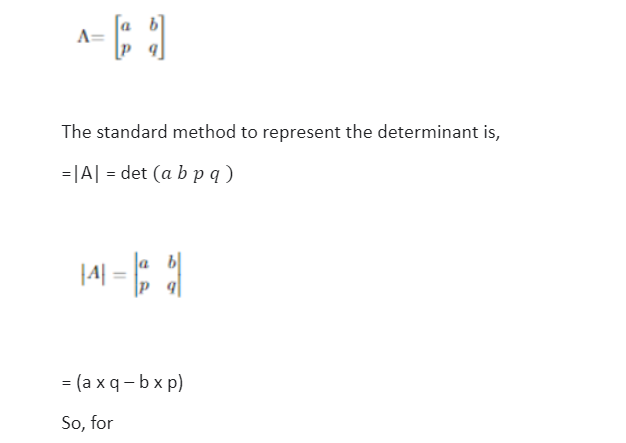
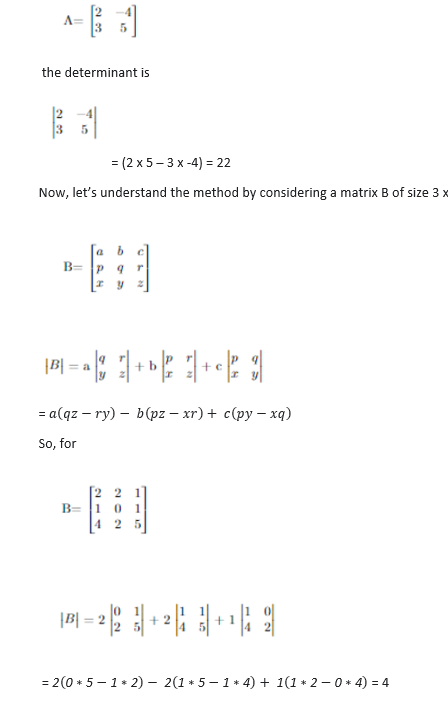
To understand the method to find determinants, let’s assume a square matrix A of size 2 x 2.
The standard method to represent the determinant is,
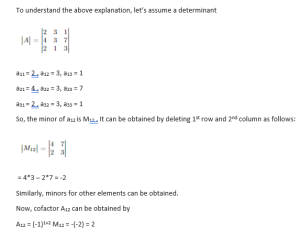
If we have a determinant |A| of size n, then the minor of any element aij can be obtained by deleting the ith row and jth column in which the aij stands. Minor of any element is represented by Mij. The cofactor is a minor with sign ( + or – ). The cofactor of aij is represented by Aij and is defined as (-1)i+j Mij.
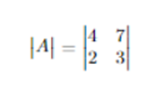
To understand the above explanation, let’s assume a determinant
The following are the common properties of determinants:
Example: If we have
then det(A) or |A| = -2
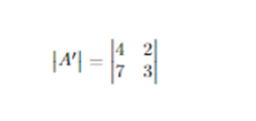
Now, interchanging rows and columns gives
then |A’| = -2
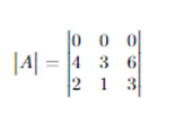
Example: If A is a determinant with all elements below diagonal are zero i.e.
then ,|A| = 2*3*3 = 18
Now, if A is a determinant with all elements above diagonal are zero i.e.
then ,|A| = 2*3*3 = 18
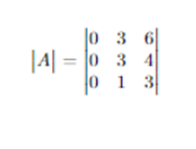
Example: If we have
then det(A) or |A| = 0
Now, for
then det(A) = |A| = 0
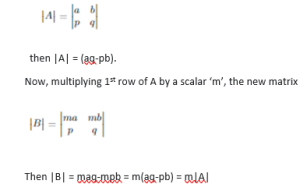
Example: If A =
then |A| = (aq-pb).
Now, multiplying 1st row of A by a scalar ‘m’, the new matrix
Then |B| = maq-mpb = m(aq-pb) = m|A|
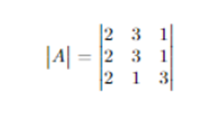
Example: if
then
|A| = 2( 3*3-1*1) – 3(2*3 – 2*1) + 1(2*1 – 2*3)
= 16-12-4
= 0
We have studied the determinant of a matrix. It is a number (may be positive, negative or complex) which is obtained by solving the matrix. This determinant is valid only for square matrices. We have also studied the properties of determinants like reflection property, triangle property, all zero property, sum property, scalar multiple property, factor property, property of multiplication, property of power, and property of proportionality. We have also studied determinants with examples. Although we discussed only 2 x 2 and 3 x 3 matrices, it can be applied to matrices of any order.


 Profile
 Settings
 Refer your friends
 Sign out