Pedigrees are utilised for various animals, including humans, dogs, and horses. They are frequently used to investigate the transmission of genetic diseases. The goal of a pedigree is to create an easy-to-read chart that displays a specific trait or disorder in a person. It can be used to describe a physical trait such as a widow’s peak or connected earlobes and genetic illnesses such as colour blindness or Huntington’s disease. Pedigrees are significant in animals that are selectively bred for specific features and represent familial characteristics in people. They serve as visual representations of an animal’s forebears, making it easier to determine if that species will pass on certain traits to its young.
A pedigree is a diagram that illustrates an organism’s biological ties between its forefathers and mothers. Since the branches and lines of a pedigree resemble a thin crane’s leg with its branching toes, it is derived from the French “pied de grue” (crane’s foot)
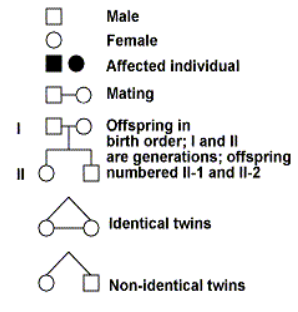
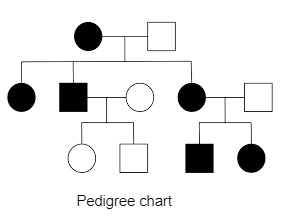
Experts use a common set of symbols to make pedigrees easier to interpret. Males are symbolised by squares, whereas circles represent females. Horizontal lines connect the parents, and vertical lines originating from horizontal lines lead to the symbols for their children. Generations are denoted by numerals, with I being the first generation, II denoting the first generation’s children, and III denoting the first generation’s grandchildren.
Pedigrees are fascinating because they can be used to solve crimes and frequently help study the genetics of inherited disorders. Pedigrees can be examined to discover the mechanism of transmission of a hereditary condition, for example:
First, you must determine if the characteristic is recessive or dominant. If the trait is dominant, it must be present in one of the parents. Dominant qualities do not pass down through generations. If the characteristic is recessive, neither parent must have it because they can be heterozygous for it.
Determine whether the attribute in the chart is autosomal or sex-linked (typically X-linked). Males, for example, are far more likely than females to be impacted by X-linked recessive characteristics. Both males and females are equally susceptible to autosomal characteristics (usually in equal proportions).
After collecting phenotypic data from several generations and drawing a pedigree, a rigorous examination will reveal whether the trait is dominant or recessive.
When it comes to qualities influenced by dominant genes, remember that affected people have at least one affected parent, and the phenotype appears in every generation. Two unaffected parents have solely unaffected offspring.
The presence of multiple affected members in a family does not always indicate that the character is dominant. The labels ‘dominant’ and ‘recessive’ refer to how a feature is exhibited, rather than how frequently it appears in a family. A recessive characteristic can appear in all generations of a lineage, although uncommon.
A pedigree may not always be sufficient to ascertain an individual’s genotype. For some traits, an individual can be homozygous dominant or heterozygous. We can often discover genotypes by looking at a person’s interactions with their parents, siblings, and offspring. However, not all carriers are always expressly identified in a pedigree, and determining solely on the information presented may be impossible.
All the conclusions we’ve made so far on gene action (dominant, recessive, codominant) have come from examining the results of controlled crossings. We may not be able to do controlled crosses in some circumstances. Instead, we must examine the current population. When it comes to human genetics, this is always the case. Pedigree analysis is a new method devised by scientists to study the inheritance of genes in people. Pedigree analysis is also valuable when investigating any population with limited progeny data from multiple generations of animals with a long generation time.


 Profile
 Settings
 Refer your friends
 Sign out