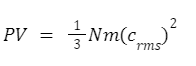
Kinetic theory is a theoretical model that describes the molecular composition of gases concerning the evaluation of a large volume of submicroscopic particles such as atoms and molecules. This theory preaches that gas pressure tends to increase when particles collide with each other within a wall of a container. Kinetic theory of gases also defines properties of the gases such as thermal conductivity, mass diffusivity, and viscosity. Overall this theory provides a basic explanation of all the properties of gases related to the microscopic phenomenon. This theory is deemed significant because it helps in the development of a correlation between macroscopic properties and microscopic phenomena. In other words, kinetic theory helps in understanding and evaluating the action of molecules of gases that are consistently in motion. Due to consistent motion, molecules tend to collide with each other as well as with the walls of the containers in which they are placed or stored.
Kinetic theory of gases tends to consider atoms and molecules of any gas as consistently moving masses that have huge inter-particle distances and could undergo elastic collisions. Implications of these assumptions are as follows:
The kinetic theory tends to function on the following postulations for an adequate understanding of the macroscopic properties of gases:
Where P denotes the gas’s pressure.
V is the volume of the gas
m is the mass of each gas molecule.
N is the total number of gas molecules in the volume V.
crms is the gas’s root mean square speed.
Overall Kinetic theory of gases focuses on considering the gas molecules as particles so that their movement and volume can be calculated. As per this theory, the pressure on gas molecules increases when they collide with each other or the surface of a container. Using this theory, multiple properties of gases are evaluated and determined.


 Profile
 Settings
 Refer your friends
 Sign out