The process by which a particle changes its position in relation to time is known as motion. The motion of a body establishes a frame of reference for the observer and determines changes in the body’s position and relative to the frame, as well as changes in time. Mechanics is a discipline of physics that studies the causes and effects of particle motion, stiff objects, and deformable bodies, among other things. Statics and Dynamics are the two streams that make up mechanics. Kinematics and Kinetics are two types of dynamics.
Kinematics is a discipline of physics that describes the motion of objects without regard to their cause. Kinetics is the branch of mechanics dealing with the factors that drive bodies to move.
Some examples of rectilinear motion from our daily lives.
Distance: It is the overall distance that the object/particle has travelled. If an object goes 2 metres ahead and 10 metres backward, the total distance travelled is 2 + 10 = 12 metres.
Displacement: It’s the total distance travelled by a moving object between its start and finish points. For example, if an object moves 100 kilometres ahead and 50 kilometres backward, the object’s total displacement is (100 – 50) = 50 kilometres. This indicates that the object is located 5 kilometres from the starting position.
Average Velocity: The rate of displacement or change in the location of an object with respect to time is known as average velocity. The metre per second (m/s) is the SI unit of average velocity. Both average and instantaneous velocity are said to be identical when velocity is kept constant.
Instantaneous Velocity: It’s defined as the distance travelled in a single instant of time. The metre per second is the SI unit of instantaneous velocity. When a particle’s acceleration is zero, the average and instantaneous velocity are said to be equal.
Average Speed: It is defined as an object’s total distance travelled in a given period of time. It’s a number with a scalar value. It is measured in magnitude and has no discernible direction.
Average acceleration: For a given interval, it is defined as the ratio of change in velocity to change in time. It’s a quantity with a vector. It’s the difference between the final velocity and the initial velocity divided by the time taken.
The velocity is constant in this sort of linear motion. There is no net external force exerted on the object and no acceleration.
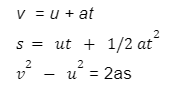
Kinematic Equations are linear motions in which the velocity changes but the acceleration remains constant. The three equations of motion can be used to calculate the motion of a body.
Where
v is the final velocity
u is the initial velocity
a is the acceleration
t is the time
and s is the displacement
Neither the velocity nor the acceleration are constant in this situation. Both can change over time.
One of the most ubiquitous phenomena we encounter in our daily lives is motion. A moving car, a child jogging down the street, or a fly flying through the air, for example, are all considered to be in motion. In general, a body is considered to be in motion if its location varies in relation to a reference point and time. The motion of a particle can vary depending on its path, such as projectile motion, rectilinear motion, rotating motion, and so on. For the time being, we’ll just concentrate on rectilinear motion, also known as linear motion.


 Profile
 Settings
 Refer your friends
 Sign out