In the language of mathematics, how do you express the students of a class, the employees in a company, or simply a group of randomly chosen colours? The answer is simple—sets. A set is a collection of distinct objects forming a group, which can have natural numbers, whole numbers, real numbers, or even days of a week, types of vehicles, etc. Eg. A= {1,2,3,4,5}
Now, a set’s elements can be uniquely related to each other or the elements of a different set. For example, In a class, students can be friends among themselves or with the students of another class. In mathematics, such mappings are called relations.
Let’s understand further what relations are and how they are represented. And also types of sets in mathematics.
Before we understand this, let’s understand the concept of Cartesian products.
Let’s say we have two sets: A= {1,2} and B= {1,7,8}. We know that you can multiply two vectors (scalar and vector products) or two matrices. Descartes claimed that it was possible to multiply two sets in the same way—map each element of the first set with each element of the second.
Thus A × B= {(1,1), (1,7), (1,8), (2,1), (2,7), (2,8)}. This product is called the Cartesian product of sets. Each element, e.g. (1,1), is called an ordered pair.
Note:
A × B ≠ B×A
A relation in Mathematics is a subset of the Cartesian product of two sets. The elements of the ordered pair in a relation follow a set rule.
Let’s take the sets A= {1,2,3} and B= {4,7,8,9}. We define a relation R: A→B.
R= {(a, b): a ∈ A, b ∈ B, b=a2}, where b is the image of preimage a.
By this rule, 2 from A can be mapped with four from B. Therefore (2,4) becomes a member of R. Similarly, three can also be mapped with 9. None of the other elements of A can be mapped this way.
Therefore, R = {(2,4), (3,9)}.
Preimage | Image |
2 | 4 |
3 | 9 |
Let’s say we have two sets, A and B. A = {1,2,3} and B = {0,1,2,4}. We want to represent a relation R which contains all the ordered pairs (a, b), where a ∈ A, b ∈ B, and a ≤ b.
There are many ways to represent the relation R. Down below, we have discussed the six most common ones.
This method simply lists the ordered pairs of the relation R in a set.
RA→B = {(1,1), (1,2), (1,4), (2,2), (2,4), (3,4)}
In this method, you state the conditions that the ordered pairs of the relation must satisfy. Using these conditions, it must be possible to derive R in its roaster form.
RA→B = {(a, b): a ∈ A, b ∈ B, a ≤ b}
As the name suggests, you write down the relation in statements, stating every condition that the relation abides by.
E.g., For all a∈ A, b ∈ B, a is related to b if and only if a ≤ b.
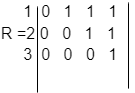
A matrix can represent the ordered pairs of the Cartesian product of two matrices A and B, wherein the elements of A can denote the rows, and B can denote the columns. For every ordered pair thus obtained, if you put 1 if it exists in the relation and 0 if it doesn’t, you get the matrix representation of the relation.
For A = {1,2,3} and B = {0,1,2,4}, and RA→B = {(a, b): a ∈ A, b ∈ B, a ≤ b}, we’ll have a 3×4 matrix as follows.
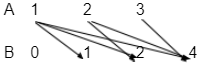
You write all the elements of a set in a row. This way, you obtain two rows—domain and co-domain. Use arrows to map the preimages with their images to represent the relation.
For A = {1,2,3} and B = {0,1,2,4}, and RA→B = {(a, b): a ∈ A, b ∈ B, a ≤ b},
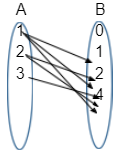
It is a simple diagrammatic representation of the relation R.
For A = {1,2,3} and B = {0,1,2,4}, and RA→B = {(a, b): a ∈ A, b ∈ B, a ≤ b},
The following are the major types of sets:


 Profile
 Settings
 Refer your friends
 Sign out