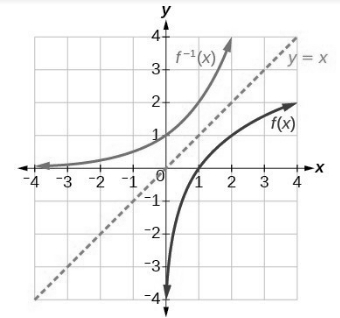
A function from a set X to a set Y allocates one element of Y to each element of X in mathematics. [1] The set X is referred to as the function’s domain, while the set Y is referred to as the function’s codomain.
The value of a function f at an element x in its domain is denoted by f. (x).
The set of all pairs (x, f (x)), known as the graph of the function, represents a function uniquely.
When the domain and codomain are both real values, each pair can be considered the Cartesian coordinates of a point in the plane. The graph of the function is a popular way of showing the function and is made up of these points.
An inverse function of a function f (also known as the inverse of f) is a function that reverses the operation of the function f. The inverse of f exists only if and only if f is bijective, and is denoted by f-1if it does.
The inverse of a function f: x-y is f-1: Each element y∊Y is sent to the unique element x∊X in such a way that f(x) = y.
One-to-one functions are those that have an inverse.
A function is said to be one-to-one if there is precisely one integer x in the domain of f such that f (x) = y for any number y in the range of f.
To put it another way, the domain and range of a one-to-one function are related as follows:
f-1 domain = f’s range
f-1 range = f’s domain
The procedure below will assist you in quickly determining the inverse of a function. In this example, we’ll look at the function f(x) = ax + b and try to discover its inverse using the techniques below.
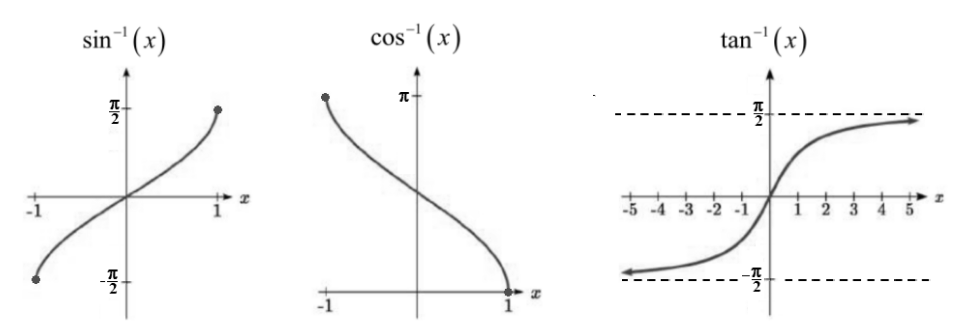
Because the six fundamental trigonometric functions are periodic, they are not one-to-one. However, we may define the inverse of a trigonometric function if we limit its domain to a one-to-one interval. Take the sine function as an example. The sine function is one-to-one on an infinite number of intervals, but the domain is usually restricted to the range[-π2,2]. By doing so, we define the inverse sine function on the domain [-1,1], which tells us which angle θ in the interval [-π2,2] satisfies sinθ = x for any x in the interval [-1,1].
Examples:
f(x) = 3x-2
Replace f(x) with y
y = 3x-2
Swap x with y
x = 3y-2
Solve for y
y = x/3 + 2/3
Finally replace y with f-1x
f-1x = x/3 + 2/3
Replace f(x) with y
y=(3x+2)/(x-1)
Swapping x and y
x=(3y+2)/(y-1)
Solving y in terms of x
x(y-1)=3y+2
xy-x=3y+2
xy-3y=x+2
y(x-3)=x+2
y=(x+2)/(x-3)
Therefore y=f-1x=(x+2)/(x-3)
An inverse function is denoted by the signf-1x. If f (x) and g (x) are inverses of each other, for example, we can represent this statement symbolically as:
f(x) = g-1(x) or g(x) = f-1(x)


 Profile
 Settings
 Refer your friends
 Sign out