A geometric sequence, in algebra, is a set of integers in which the ratio of any two consecutive terms is constant. The common ratio of the sequence is the name given to this constant. For example, 1, 2, 4, 8 is a geometric sequence with a common ratio of 2 and 100. -50, 25, -25/2 is a geometric sequence with a common ratio of -½; however, 1, 3, 9, -27 and -3, 1, 5, 9… are not geometric sequences as the ratio between the consecutive terms varies. More formally, the sequence a1, a2…anis a geometric progression if and only if a2/a1 = a3/a2 = an/an-1
Amount of nth term of geometric progression:
A mathematics series is an infinite number of terms with the purpose of maintaining a consistent proportion between the successive terms.
In a geometric progression, we use a mathematical series of limited terms to infer the equation to track down the quantity of the geometric progression because the typical proportion between the progressive terms is fixed.
For instance, if there are 10 terms in a sequence, and each term is multiplied by the next term, it is known as geometric progression. In this scenario, the number that is subsequently used to multiply is called the common ratio. Whereas in arithmetic progression, when the nth term is subtracted from (n-1)th term, there will be a constant difference between any two numbers. Arithmetic progression is written as:
x, x+b, x+2b, x+3b, x+… x+ (n-1) b
Take this sequence:
3, 6, 12, 24, 48…and it goes on.
6/3= 2
12/6= 2
24/12= 2
48/24= 2
Similarly, for example:
1, ⅓, ⅙, 1/12, 1/24, 1/48…
⅓ / 1 = ½
¼ / ½ = ½
⅛ / ¼ = ½
1/16 / ⅛ = ½
1/24 / 1/16 = ½
1/48 / 1/24 = ½
The ratio between any two successive numbers is the only item that remains constant in the above instances. Geometric progression is the name given to these sequences.
If a sequence x1, x2 , x3, x4, … xn is a geometric progression,
ak+1 / ak= r (k is always greater than 1)
Here,
r= is a constant ratio between two numbers
The nth term of arithmetic progression was:
xn = x+ (n-1) b
In the case of geometric progression let us take
x is the first number and r is the common ratio between all the numbers.
The second term will be: x2= x1 *r
The third term will be: x3 = x2*r = x1*r*r = xr2
The nth term will be: xn = x * rn-1
The general term will be = xn = x1* rn-1
Common ratio help in determining the nature of geometric progression.
1. 10, 30, 90, 270, 810, 2430…
This sequence has 3 as a factor between each number.
The value of a and r are:
a = 10 (the first term)
r = 3 (the common ratio)
The rule for any term is:
xn = 10 × 3n-1
The 4th term is:
x4 = 10 × 34-1 = 10 × 33
= 10* 27 = 270
The 10th term is:
x10 = 10 × 310-1 = 10 × 39
= 10 * 19683 = 196830
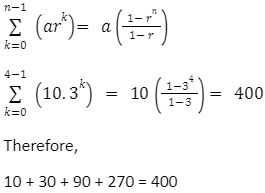
2. The sum of the first 4 terms of 10, 30, 90, 270, 810, 2430…
This sequence has a factor of 3 between each number.
The values of a, r and n are:
a= 10 (the first term)
r= 3 (the common ratio)
n= 4 ( sum of the first 4 terms)
So:
To find the nth term in a progression, use the geometric progression formula. We need the first term and the common ratio to find the nth term. If you don’t know what the common ratio is, you can figure it out by dividing any term by its previous term. We must multiply with a set term known as the common ratio every time we want to find the next term in the geometric progression, and we must divide the term with the same common ratio every time we want to get the preceding term in the progression. Example: A GP with a common ratio of 2 is 2, 4, 8, 16, 32, and so on.
There are two types of geometric progressions: finite and infinite. Its common ratio might be either positive or negative.


 Profile
 Settings
 Refer your friends
 Sign out