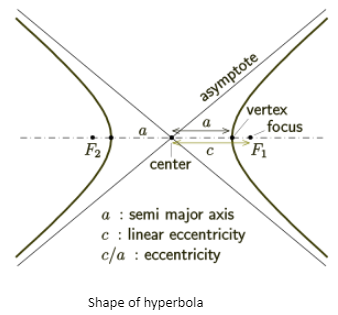
A hyperbola is a smooth curve in space that has two connected components or branches that are mirror images of each other and resemble two infinite bows. A hyperbola is a set of points with a constant difference in distance between two foci. When you cut a double cone vertically, you get a hyperbola as a mathematical shape. Many people learn about this shape in high school or college algebra classes, but it is not clear why this shape is important. The hyperbola has a few characteristics that allow it to be useful in the real world. Hyperbolas are used in many fields to design and predict phenomena.
A hyperbola is a smooth curve that lies in a plane and is described by its geometric properties or by equations for which it is the solution set in mathematics. A hyperbola is made up of two parts, known as connected components or branches, that are mirror reflections of one another and resemble two infinite bows. The intersection of a plane with a double cone forms the hyperbola, one of three types of conic sections. (The parabola and ellipse are the other conic sections.) An ellipse is a specific instance of a circle.) The conic is a hyperbola if the plane overlaps both parts of the double cone but does not pass through the apex of the cones.
Hyperbolas can appear in a variety of ways:
and so on.
Each hyperbola branch has two arms that become straighter (lower curvature) as they move away from the centre. One branch’s diagonally opposing arms tend to converge on a single line, known as the asymptote of the two arms. As a result, there are two asymptotes, one of which intersects at the hyperbola’s centre of symmetry, which can be thought of as the mirror point around which each branch reflects to generate the other branch. The two coordinate axes are the asymptotes in the case of the curve y(x)=1/x.
The general equation of a hyperbola is represented by the equation below. The x-axis represents the hyperbola’s transverse axis, and the y-axis represents the hyperbola’s conjugate axis.
A hyperbola intersecting a plane with both halves of a double curve yields a two separate curve. The plane need not be parallel to the cone’s axis; the hyperbola will be symmetrical irrespective.
You can see the following in the above diagram:
The hyperbola has a few characteristics that allow it to be useful in the real world. Hyperbolas are used in many fields to design and predict phenomena. The task of locating a point based on differences in its distances from other points or, to put it another way, the difference in distances between two points. Arrival times of co – ordinated signals between the point and the given points is solved using a hyperbola.


 Profile
 Settings
 Refer your friends
 Sign out